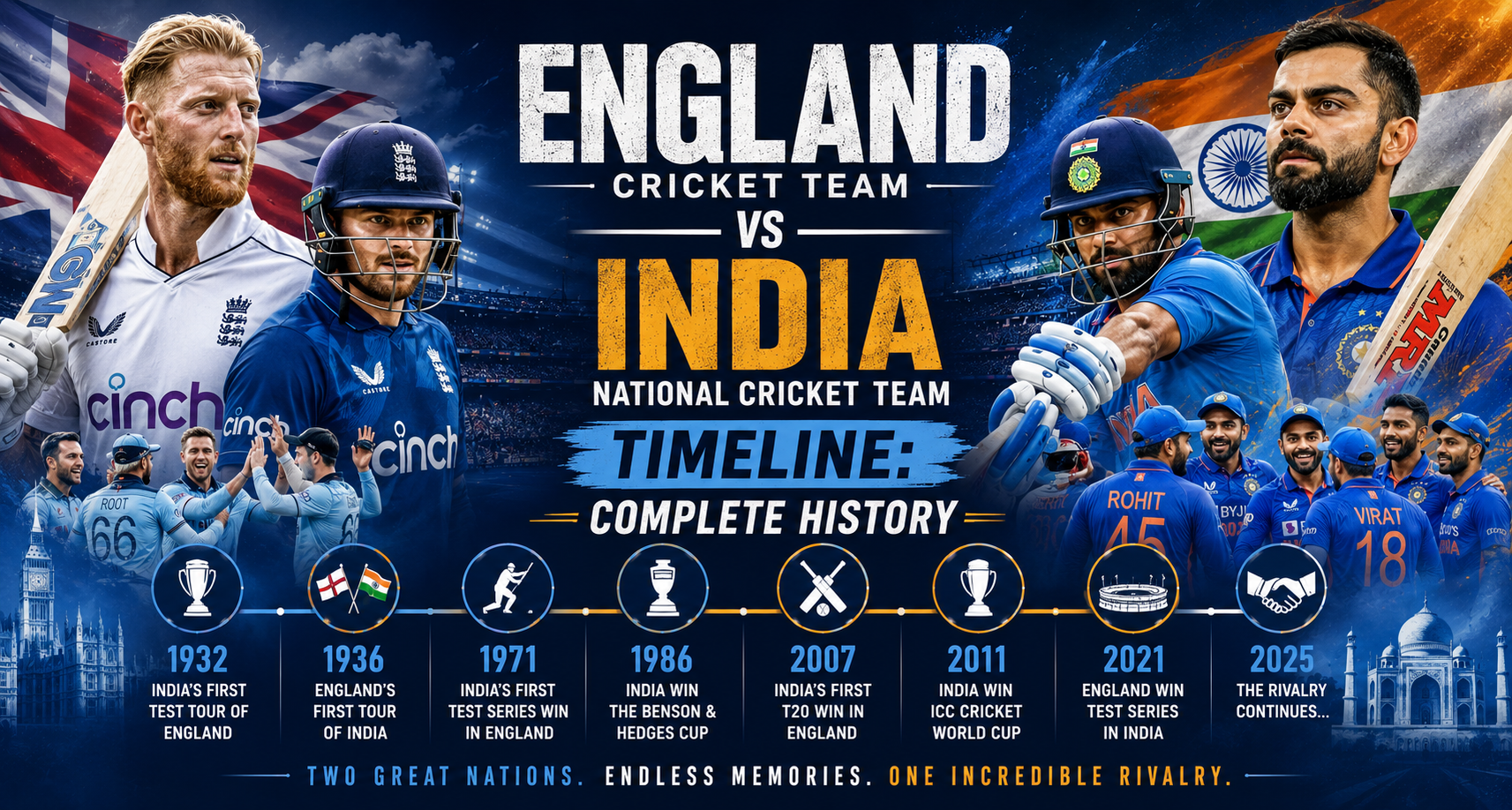
No fixture in international cricket carries the same combination of historical depth, cultural weight, and bilateral intensity as the contest between the England cricket team vs India national cricket team. Dating back to June 25, 1932 — when India played their very first Test match at Lord’s, losing by 158 runs to a country that had then governed the subcontinent for nearly two centuries — this rivalry has evolved over 94 years from a politically charged colonial encounter into a contest between two of the most powerful cricketing nations on the planet. Cricket fans across India, the United Kingdom, and the UAE — watching on JioHotstar, Star Sports, and Sky Sports — have followed every chapter of this extraordinary story: from Kapil Dev’s World Cup semifinal triumph at Old Trafford in 1983, to Yuvraj Singh’s six sixes off Stuart Broad at Durban, to Shubman Gill’s monumental 269 at Edgbaston in 2025 and India’s dramatic six-run victory in the series-levelling fifth Test at The Oval. This comprehensive England cricket team vs India national cricket team timeline covers every significant era, format, iconic match, scorecard, and player who has defined one of cricket’s oldest and most consequential rivalries.
Rivalry Overview & Overall Head-to-Head Records
While England has dominated the Test arena with 53 wins compared to India’s 37, India has shown superior performance in limited-overs cricket, leading both the ODI and T20I head-to-head records. The India-England cricket rivalry represents one of cricket’s oldest and most storied contests.
England and India have faced each other on more than 267 occasions across all formats. The England vs India Test series is named the Pataudi Trophy when it is played in England and the Anthony de Mello Trophy when it is played in India.
The rivalry’s most compelling feature is its stark format-specific split — a characteristic that makes every bilateral series a genuinely different contest with genuinely different favourites depending on conditions, format, and the specific squads assembled. England’s Test dominance, built over more than ninety years of cricket, contrasts sharply with India’s growing stranglehold on white-ball cricket — the ODI and T20I formats that have become Indian cricket’s commercial and sporting heartland. India has managed to win just three Test series in England, and the last time that happened was in 2007. England last won a Test series in India during the 2012-13 series. This geographical home-advantage pattern defines the Test rivalry more than any other bilateral series in world cricket — both teams performing exponentially better in their own conditions than in their opponents’ environment.
Read More: Pataudi Trophy — Complete Test Series History, Results & Records
Era 1 — Colonial Beginnings (1932–1951): England’s Complete Dominance
June 25, 1932 — Lord’s, London: The First Match
India’s national cricket team did not play its first Test match until June 25, 1932 at Lord’s, becoming the sixth team to be granted Test cricket status. India played their first-ever Test match against England, which England won by 158 runs.
The inaugural encounter between these nations at Lord’s — cricket’s most symbolic ground, representing both the sport’s establishment and, for the Indian touring party, the seat of imperial power — carried a political charge that no subsequent match between these teams has quite replicated. India’s 147 and 93 in their two innings, against England’s 259 and a modest chase, reflected a touring team’s inexperience rather than their talent. C.K. Nayudu, India’s first Test captain, led a squad that included players whose cricket education had been conducted in the very colonial structures they were now competing against.
England dominated comprehensively through the 1930s and 1940s, winning every Test series between the nations. India’s batting — reliant on the elegance of Vijay Merchant, the solidity of Mushtaq Ali, and Nayudu’s all-round skills — could occasionally produce impressive first innings totals but lacked the bowling depth to dismiss England twice across five days on English pitches that assisted seam throughout.
1946 — India’s First Post-War Tour
India’s 1946 tour of England — their first after the Second World War and on the eve of Indian independence — produced competitive cricket despite a 1-0 series defeat. Vijay Merchant’s batting, combining classical technique with extraordinary patience, gave England’s bowlers more problems than any previous Indian touring side had managed. The tour also marked the beginning of India’s transition toward a cricket identity more independent of colonial influence — a transition that would accelerate dramatically following independence in 1947.
Era 2 — India’s First Victories (1952–1970): Breaking the Barrier
February 1952 — Madras: India’s First Test Victory Against England
India first tasted victory in Test cricket against England in 1952 at Madras Cricket Club Ground. Twenty years after their first Test, India finally defeated England — a victory that arrived on home soil against a touring English side that underestimated the spinning conditions and found themselves unprepared for the combination of Vinoo Mankad’s slow left-arm spin and the assistance Madras’s Chepauk pitch provided.
The 1952 victory — achieved inside four days — established a template that would define India’s home Test dominance for the next seven decades: subcontinental conditions favouring spin, English batsmen struggling to read variations they had insufficient domestic exposure to develop techniques against, and India’s spinners exploiting conditions that their bowlers understood intuitively. India won the series 1-0, their first home series victory over England, and a psychological milestone for a nation that had gained political independence just five years earlier.
1967 — Pataudi’s India Find Their Feet Away
The Nawab of Pataudi’s captaincy — combining tactical astuteness with an inspirational leadership style that transformed India’s touring mentality — produced their most competitive away performances to that point against England. While Test series victories in England remained elusive, individual performances of the era — Farokh Engineer’s wicketkeeping batting, Chandrasekhar’s leg-spin variations that troubled England’s batsmen in both home and away conditions — confirmed that India were developing the depth of talent required to compete consistently at Test level beyond their subcontinental stronghold.
Era 3 — The Gavaskar–Kapil Era (1971–1986): India’s Global Rise
1971 — Ajit Wadekar’s Historic Series Win in England
India’s 1971 tour of England, led by Ajit Wadekar, produced their first Test series win on English soil — a 1-0 victory built on the spin of Bishan Singh Bedi, Erapalli Prasanna, Bhagwath Chandrasekhar, and S. Venkataraghavan, and the batting of Sunil Gavaskar and Dilip Sardesai. The Oval Test victory — India’s first on English soil — was the defining result of a summer that announced India’s emergence as a genuine world cricket power.
Gavaskar’s batting — technically correct, psychologically unshakeable, and built on a mastery of the forward defensive stroke that made him virtually impossible to dismiss in difficult conditions — gave India a batting foundation comparable to any Test team in the world. His ability to bat through full days, building partnerships methodically while never losing sight of the match’s broader context, made him the defining batsman of India’s transformation from also-rans to contenders.
1983 World Cup Semifinal — Kapil Dev’s India Stun England
India’s victory over England in the 1983 Prudential World Cup semifinal at Old Trafford, Manchester was the stepping stone to the most consequential moment in Indian cricket history — their first World Cup title. India’s semifinal match was against hosts England at Manchester. Batting first, England were all out for 213 runs with Kapil Dev taking three wickets. India chased the target with Sharma and Patil scoring half-centuries, to win by six wickets.
Kapil Dev, Roger Binny’s combined five wickets, Mohinder Amarnath’s all-round display, Yashpal Sharma’s well-made half-century and Sandeep Patil’s blazing fifty helped India to a tense six-wicket victory over England. Sandeep Patil hammered a 32-ball fastest fifty by an Indian batsman in World Cup history. The match’s significance extended far beyond its scoreboard — India’s confident, attacking approach against a home England team playing in front of their own crowd at a ground where subcontinental teams had historically found the conditions most hostile confirmed Kapil Dev’s squad as genuine title contenders rather than fortunate participants.
1986 — India Win a Test Series in England
The 1986 tour of England saw India win a Test series in England again, led by Kapil Dev. The emergence of players like Mohammad Azharuddin, Dilip Vengsarkar, and Ravi Shastri made India more competitive away from home. The Test series victory in 1986 in England remained, for nearly 19 years, the last Test series win outside the subcontinent. Dilip Vengsarkar’s century at Lord’s — his third consecutive Test hundred at cricket’s most celebrated ground — and the spin bowling of Maninder Singh gave India the weapons to win individual Test matches in conditions that had historically favoured England comprehensively.
Era 4 — Tendulkar’s Emergence (1990–2001): A Rivalry Reborn
August 1990 — Old Trafford: A 17-Year-Old Announces His Genius
In the 1990s, the rivalry intensified with the arrival of iconic players like Sachin Tendulkar and Anil Kumble for India, and Michael Atherton, Graham Gooch, and Darren Gough for England. Tendulkar scored his first Test century at Old Trafford in 1990, signaling the arrival of one of the game’s all-time greats.
Tendulkar’s 119 at Old Trafford — scored at 17 years and 112 days, making him the youngest Indian to score a Test century at that point — was not merely a statistical achievement but a statement of a cricketing intelligence that operated on a plane beyond the limitations of age. His ability to play Devon Malcolm’s pace without flinching, his driving through the off-side against Graham Gooch’s medium pace, and his understanding of when to attack and when to accumulate across a full day of Test batting confirmed what Indian cricket insiders had known since his debut the previous year — this was a talent of the rarest possible order.
The Atherton–Tendulkar Duels (1996–1999)
The individual contest between Michael Atherton’s gritty, technically correct opening batting and Tendulkar’s attacking genius defined the bilateral encounters of the mid-to-late 1990s. Atherton’s hundreds in India — achieved against Kumble’s leg-spin on turning pitches with the composure of a batsman who had mastered the conditions through preparation and resolve — gave England their competitive moments against a generation of Indian batsmen who were individually extraordinary but collectively inconsistent.
England’s 1996 series victory in India — built on the quality of Dominic Cork’s swing bowling and Jack Russell’s wicketkeeping batting in difficult conditions — represented the last sustained period of English dominance in India before the Dravid-Tendulkar-Ganguly generation reached full maturity and made India’s home conditions effectively unwinnable for visiting teams.
Read More: Sachin Tendulkar vs England — Century Records, Iconic Innings & Test Series Stats
Era 5 — Ganguly’s India & The Iconic NatWest Final (2002–2007)
July 13, 2002 — Lord’s, London: Kaif and Yuvraj’s Immortal Chase
The 2002 NatWest Series final at Lord’s stands as the single most celebrated India vs England one-day encounter of the entire rivalry — a match that combined an imposing England total, the apparent certainty of Indian defeat at 146/5, and then the most dramatic ODI comeback the rivalry had ever produced.
England scored a mammoth total of 326-8 in 50 overs with top scorer Nasser Hussain 115 off 128 balls — his maiden ODI hundred — and Marcus Trescothick 109 off 100 balls. India best bowler Zaheer Khan picked up three wickets.
India were almost dead and buried at 146/5 in the 24th over. It took a special innings of 87 from Mohammad Kaif and a 69 off 63 balls by Yuvraj Singh. India have won by two wickets! India celebrate — what should be one of the most astonishing run chases. Ganguly kissed the hallowed turf at Lord’s. India have finally got the monkey off their back — the run of nine losses in the final of multi-team tournaments is now history.
The famous image of Sourav Ganguly removing his shirt and waving it above his head on Lord’s balcony — celebrating in the home of cricket, in the ground most associated with the establishment that had governed India for two centuries — captured a moment of cultural significance that extended far beyond the cricket. Ganguly’s gesture was read across India as a statement of arrival, confidence, and the end of cricket deference. Mohammad Kaif’s unbeaten 87 and Yuvraj Singh’s 69 had done the batting work; Ganguly’s celebration did the symbolic work that the match demanded.
2002 Test Series — Dravid’s Greatest Tour
The series in England in 2002 is billed as Rahul Dravid’s series, as he became the top scorer for the Indians, with centuries coming at Trent Bridge in Nottingham, Headingley in Leeds and a famous 217 at The Oval in London. Three centuries in a single Test series in England — including a 217 at The Oval that remains among the finest individual batting performances by an Indian batsman on English soil — confirmed Dravid as the most technically complete batsman of his generation in conditions that challenged the fundamental assumptions of subcontinental batting technique.
2007 — India’s Last Test Series Win in England
India managed to win a Test series in England in 2007 — the last time they achieved that result, making it the most recent of their three series victories on English soil. The series result — achieved with key performances from Zaheer Khan’s reverse swing bowling and Dravid’s batting authority — established the high-water mark of India’s Test cricket in England from that era, a summit that subsequent Indian touring teams have consistently attempted to reach across the following 18 years without success.
Era 6 — Yuvraj’s Six Sixes & India’s T20 Emergence (2007–2012)
September 19, 2007 — Durban: T20 Cricket’s Most Iconic Individual Over
The first T20I between India and England — played as part of the inaugural ICC World Twenty20 tournament in South Africa — produced the single most celebrated individual over in the format’s history.
In India’s Super 8 match against England at Durban, Yuvraj Singh hit six sixes in an over off Stuart Broad. In the process, he reached the fastest fifty ever in a Twenty20 game (involving Test playing nations), off just 12 balls, which was also the fastest in any form of international cricket. This was the fourth time that six sixes had been hit in one over in senior cricket, the first time in Twenty20 cricket, and the first time in any form of international cricket against a bowler from a Test playing nation.
Yuvraj was the main man of the day with six sixes in a single over off Stuart Broad, to become the fourth man in senior cricket to achieve the feat, after Garry Sobers, Ravi Shastri and Herschelle Gibbs. Each delivery — dispatched over a different boundary — demonstrated a different dimension of Yuvraj’s extraordinary hitting: the first over extra cover, the second over long-on, the third pulled over square leg, the fourth carved over deep point, the fifth lofted straight, the sixth cleared mid-wicket with brutal simplicity. Broad stood at the end of the over having conceded 36 runs in six deliveries — a personal cricketing nightmare that he would spend the following decade contextualising in interviews but ultimately accepting as an inescapable part of his legacy.
India won the inaugural T20 World Cup that tournament, with Yuvraj’s performance against England the defining moment of their journey.
2011 — England’s World Cup Revenge at Group Stage
At the 2011 ICC Cricket World Cup in India, England met India in a group stage encounter at Bangalore that produced one of the tournament’s most dramatic finishes. India and England have faced each other nine times in ICC Cricket World Cups and thrice in ICC Champions Trophies. The match — a tied result that required a Super Over to separate the teams — gave England their moment of satisfaction after years of India’s growing white-ball dominance, confirming that in ICC tournament cricket specifically, the rivalry remained genuinely competitive rather than one-sided.
Era 7 — Pataudi Trophy Battles & Format Split (2012–2021)
2012 — England’s Last Test Series Win in India
England last won a Test series in India during the 2012-13 series, which was the last time a team won a Test series in India before New Zealand last year. England’s 2012 series victory — achieved through the off-spin of Monty Panesar and Graeme Swann operating in tandem on turning pitches, combined with Kevin Pietersen’s extraordinary batting against spin — produced one of the landmark results in recent bilateral history. India’s home fortress, considered virtually impregnable through the preceding decade, was breached comprehensively by England’s superior preparation and spin-playing technique.
2018 — England Win the Pataudi Trophy 4-1
England’s 2018 series victory in England — a 4-1 margin that flattered them slightly but reflected genuine quality from James Anderson, Stuart Broad, and the emerging Sam Curran — produced India’s heaviest Test series defeat on English soil. Virat Kohli’s 593 series runs — scored across multiple hundreds in a losing cause — confirmed his individual class while simultaneously underscoring his team’s collective vulnerability against quality swing bowling in SENA conditions.
2020 — England Beaten Comprehensively in India
India’s 3-1 home Test series victory in 2020-21 over England — built on the mastery of Ravichandran Ashwin and Washington Sundar’s spin bowling on the Chepauk and Ahmedabad pitches — produced the comprehensive home reversal of the 2018 result. England’s batsmen, arriving without adequate preparation for the extreme turn and variable bounce that Indian pitches produced, found themselves as helpless against Indian spin as Indian batsmen had been against English swing two years earlier.
2024 T20 World Cup Semifinal — India Book Their Place in the Final
India won their last meeting against England in the semi-final of the ICC T20 World Cup 2024 by 68 runs. India’s dominant semifinal performance — reducing England to a total they could not defend through a combination of Bumrah’s pace mastery and Axar Patel’s left-arm spin — confirmed that in ICC T20 tournament cricket, India had developed a near-unassailable advantage over England built on superior depth, experience under pressure, and the specific batting and bowling combinations that the shortest format rewards.
Era 8 — Bazball, Bumrah & The 2025 Anderson-Tendulkar Trophy: The Greatest Modern Series
The 2025 Test series in England — five matches across the summer, played under the Anderson-Tendulkar Trophy designation — produced the most consistently high-quality bilateral Test cricket between these teams in the modern era, a series that combined Ben Stokes’s Bazball philosophy with India’s new-generation batting and pace bowling depth in conditions that tested every player’s technique, temperament, and tactical adaptability.
The win not only squared the Anderson-Tendulkar Trophy at 2-2 but also gave India’s ICC World Test Championship campaign a significant boost, propelling them to third in the standings.
2nd Test — Edgbaston: Shubman Gill’s 269 & India’s Dominant Win
Shubman Gill piled on the highest-ever score by an Indian captain to drive England into the ground at Edgbaston, reaching his first Test double-hundred and walking off unbeaten on 265 at the tea interval. Shubman Gill’s 269, the seventh-highest score in India’s Test history. Gill’s innings — accumulated with a combination of technical correctness through the off-side, aggressive driving on the front foot, and an increasing authority over the short ball as the innings progressed — produced an individual batting achievement that ranks alongside Dravid’s 217 at The Oval as the finest century by an Indian batsman in England in the modern era.
Akash Deep becomes only the second Indian bowler to take a 10-wicket haul in a Test in England, Chetan Sharma is the only other Indian when he took 10/188 also at Birmingham back in 1986. Akash Deep’s ten-wicket match haul — six in the second innings to seal a 336-run India victory — combined with Gill’s batting to produce one of the most complete individual match performances from any India player on English soil.
5th Test — The Oval: Siraj’s Six-Run Victory
Heading into the fifth Test with the series on the line, facing a formidable England side at home, and without the services of Rishabh Pant and Jasprit Bumrah, few would have predicted a fightback of this magnitude from a young Indian team. A dramatic six-run victory sealed by a final-hour surge from Mohammed Siraj, who took three of the last four wickets to script a stunning turnaround.
Looking back at India’s storied away wins, this triumph at The Oval now sits alongside legendary performances at Eden Gardens in 2001 and Gabba in 2021. What makes this special is the backdrop — a transitional side, up against the hosts, succeeding in challenging conditions and holding their nerve when England needed just 35 runs with four wickets in hand.
Mohammed Siraj’s unreal resistance, playing in all five Tests, steaming in with 140 km/h deliveries even on the 25th day of play, paved the way for India’s comeback. Siraj’s pace and aggression made a big impact, landing him the most wickets in the series with 23. The 2025 series — drawn 2-2, with both teams winning Tests in which their opponents had appeared dominant — produced the kind of competitive cricket that the rivalry’s very best chapters have always delivered: no foregone conclusions, individual genius regularly overturning team advantages, and a final result that neither side could claim as definitive superiority.
Era 9 — T20 World Cup 2026 Semifinal: India Win by 7 Runs
Last Match: 2nd Semi-final in 2026 ICC T20I World Cup; India won by 7 runs at Wankhede Stadium, Mumbai on March 5, 2026. India’s victory over England in the T20 World Cup 2026 semifinal — on home soil at Mumbai’s Wankhede Stadium, in front of a capacity crowd that generated an atmosphere comparable to any cricket match played anywhere in the world — extended India’s ICC T20 tournament dominance over England to its most complete expression. The seven-run margin, decided in the tournament’s penultimate match, confirmed India’s status as the defending and current T20 World Cup champions while simultaneously demonstrating the fine margins that separate these two teams in the format’s highest-pressure moments.
Read More: ICC T20 World Cup 2026 — Complete Results, Semifinal & Final Scorecards
Iconic Match Scorecards — Full Analysis
Match 1 — 1983 World Cup Semifinal: India Stun England at Old Trafford
| Match Information | Details |
|---|---|
| Match | 1983 Prudential World Cup, 1st Semifinal |
| Venue | Old Trafford, Manchester |
| Date | June 22, 1983 |
| Toss | England won, elected to bat |
| Result | India won by 6 wickets |
| Player of the Match | Mohinder Amarnath |
England Batting
| Batsman | Runs | Balls | Key Note |
|---|---|---|---|
| Chris Tavaré | 32 | 51 | Quiet opener; fell early |
| Graeme Fowler | 33 | 59 | Top scorer — fell to Binny |
| David Gower | 17 | — | Dismissed mid-innings |
| Allan Lamb | 29 | 58 | England’s only fight in middle order |
| Mike Gatting | 18 | — | — |
| Ian Botham | — | — | Failed to fire |
Total: 213 all out (60 overs)
India Bowling
| Bowler | Overs | Runs | Wickets |
|---|---|---|---|
| Kapil Dev | 11 | 35 | 3 |
| Roger Binny | 10 | 43 | 2 |
| Mohinder Amarnath | 12 | 27 | 2 |
| Madan Lal | 12 | 22 | 2 |
| Ravi Shastri | 7 | 49 | 1 |
India Batting — Chase
| Batsman | Runs | Balls | Key Note |
|---|---|---|---|
| Sunil Gavaskar | 25 | — | Fell early at 46 |
| Kris Srikkanth | — | — | — |
| Mohinder Amarnath | Contributions | — | All-round hero |
| Yashpal Sharma | 61* | — | Half-century anchor |
| Sandeep Patil | 51* | 32 | Fastest WC fifty by Indian at time |
Total: 217/4 (54.4 overs) | Won by 6 wickets
The entire Indian team crowded on to the pavilion balcony to witness one of the greatest moments in their nation’s cricket history as Patil and the captain Kapil Dev completed victory with 5.2 overs to spare.
Match 2 — 2002 NatWest Series Final: Kaif & Yuvraj’s Miracle Chase
| Match Information | Details |
|---|---|
| Match | 2002 NatWest Series Final |
| Venue | Lord’s Cricket Ground, London |
| Date | July 13, 2002 |
| Toss | England won, elected to bat |
| Result | India won by 2 wickets |
| Player of the Match | Mohammad Kaif |
England Batting
| Batsman | Dismissal | Runs | Balls | 4s | 6s | SR |
|---|---|---|---|---|---|---|
| Marcus Trescothick | — | 109 | 100 | 7 | 2 | 109.00 |
| Nick Knight | — | — | — | — | — | — |
| Nasser Hussain (c) | — | 115 | 128 | 10 | 0 | 89.84 |
| Andrew Flintoff | — | 40 | 32 | 2 | 1 | 125.00 |
| Paul Collingwood | — | — | — | — | — | — |
Total: 325/8 (50 overs)
India Bowling
| Bowler | Overs | Runs | Wickets | Economy |
|---|---|---|---|---|
| Zaheer Khan | 10 | 68 | 3 | 6.80 |
| Anil Kumble | 10 | 48 | 1 | 4.80 |
| Ashish Nehra | 10 | 57 | 1 | 5.70 |
| Javagal Srinath | 10 | 56 | 1 | 5.60 |
| Harbhajan Singh | 10 | 90 | 0 | 9.00 |
India Batting — The Chase
| Batsman | Dismissal | Runs | Balls | 4s | 6s | SR |
|---|---|---|---|---|---|---|
| Sourav Ganguly (c) | — | — | — | — | — | — |
| Virender Sehwag | — | — | — | — | — | — |
| Dinesh Mongia | — | — | — | — | — | — |
| Rahul Dravid | — | — | — | — | — | — |
| Sachin Tendulkar | b Flintoff | — | — | — | — | — |
| Yuvraj Singh | — | 69 | 63 | 9 | 0 | 109.52 |
| Mohammad Kaif | not out | 87 | — | — | — | — |
| Harbhajan Singh | — | — | — | — | — | — |
Total: 326/8 (49.3 overs) | Won by 2 wickets
Fall of wickets: 1-106 (Sourav Ganguly), 2-114 (Virender Sehwag), 3-126 (Dinesh Mongia), 4-132 (Rahul Dravid), 5-146 (Sachin Tendulkar), 6-267 (Yuvraj Singh).
India celebrate — what should be one of the most astonishing run chases. India were almost dead and buried at 146/5 in the 24th over. It took a special innings of 87 from Kaif and a 69 off 63 balls by Yuvraj Singh. Amazing scenes here at Lord’s — India have won by two wickets!
Match 3 — 2007 ICC World T20: Yuvraj’s Six Sixes Off Stuart Broad
| Match Information | Details |
|---|---|
| Match | ICC World T20 2007, Group E Match 21 |
| Venue | Kingsmead, Durban, South Africa |
| Date | September 19, 2007 |
| Toss | India won, elected to bat |
| Result | India won by 18 runs |
| Player of the Match | Yuvraj Singh (58 off 16 balls) |
India Batting
| Batsman | Runs | Balls | 4s | 6s | SR |
|---|---|---|---|---|---|
| Gautam Gambhir | 58 | 45 | 7 | 1 | 128.89 |
| Robin Uthappa | — | — | — | — | — |
| Yuvraj Singh | 58 | 16 | 0 | 7 | 362.50 |
| MS Dhoni (c) | — | — | — | — | — |
| Rohit Sharma | — | — | — | — | — |
Total: 218/4 (20 overs)
The Historic Over (Over 19 — Stuart Broad to Yuvraj Singh)
| Ball | Result | Running Total |
|---|---|---|
| Ball 1 | Six — over extra cover | +6 |
| Ball 2 | Six — over long-on | +12 |
| Ball 3 | Six — pulled over square leg | +18 |
| Ball 4 | Six — carved over deep point | +24 |
| Ball 5 | Six — lofted straight | +30 |
| Ball 6 | Six — cleared midwicket | +36 |
Total from over: 36 runs. England captain Paul Collingwood: “I feel sorry for Stuart Broad, but it was only a matter of time before an over like that came around.”
Yuvraj Singh reached the fastest fifty ever in a Twenty20 game (involving Test playing nations), off just 12 balls. He finished his innings with 58 runs off 16 balls and won the Man of the Match. Rajasthan Royals
Match 4 — 2025 Test Series, 2nd Test: Gill’s 269 & India Win by 336 Runs
| Match Information | Details |
|---|---|
| Match | Anderson-Tendulkar Trophy 2025, 2nd Test |
| Venue | Edgbaston, Birmingham |
| Date | July 2–6, 2025 |
| Toss | — |
| Result | India won by 336 runs |
| Player of the Match | Shubman Gill (269 & 161) |
| Series Context | Series levelled 1-1 |
India 1st Innings: 587/4 declared
| Batsman | Runs | Balls | Key Note |
|---|---|---|---|
| Shubman Gill (c) | 269 | — | Highest score by Indian captain; first Test double-century |
| KL Rahul | — | — | Quality opening partner |
| Rishabh Pant | — | — | Crucial momentum-shifting fifty |
| Ravindra Jadeja | — | — | Two half-centuries in match |
This is the highest score that England have conceded in the Stokes-McCullum era, beating Pakistan’s 579ao at Rawalpindi in 2022.
England 1st & 2nd Innings Combined: collapsed below 250 combined across both innings as Akash Deep’s 10-wicket match haul proved decisive
Akash Deep becomes only the second Indian bowler to take a 10-wicket haul in a Test in England, Chetan Sharma is the only other Indian when he took 10/188 also at Birmingham back in 1986.
India 2nd Innings: 161 from Shubman Gill (c)
Result: India won by 336 runs — their biggest win at Edgbaston
Head-to-Head Records — All Formats
| Format | Matches Played | England Won | India Won | Drawn/NR/Tied |
|---|---|---|---|---|
| Tests | 141 | 53 | 37 | 51 draws |
| ODIs | 110 | 44 | 61 | 3 NR, 2 tied |
| T20Is | 30 | 12 | 18 | — |
| Overall | 281+ | ~109 | ~116 | — |
England leads 53-37 in 141 Tests with 51 draws. India has dominated England in ODIs as well as T20Is. India and England have played a total of five knockout matches in major ICC tournaments. India has won three out of these five games.
India and England have faced each other in 110 matches in ODI. Out of these 110 games, India have won 61 whereas England have come out victorious on 44 occasions. Three matches ended without a result. Two matches ended in a tie. Encounters
| Year | Tournament | Stage | Result |
|---|---|---|---|
| 1983 | ODI World Cup | Semifinal | India won by 6 wkts — went on to lift the cup |
| 2007 | ICC World T20 | Group stage | India won by 18 runs — Yuvraj’s 6 sixes |
| 2011 | ODI World Cup | Group stage | Tied — Super Over |
| 2022 | T20 World Cup | Group stage | England won by 10 wickets |
| 2023 | ODI World Cup | Group stage | India won by 100 runs |
| 2024 | T20 World Cup | Semifinal | India won by 68 runs |
| 2026 | T20 World Cup | Semifinal | India won by 7 runs |
England and India have faced each other nine times in ICC Cricket World Cups, thrice in ICC Champions Trophies, and five times in ICC T20 World Cups.
Top Run-Scorers Across All Formats
| Player | Team | Format | Runs | Notable Score |
|---|---|---|---|---|
| Sachin Tendulkar | India | Tests/ODIs | 2,000+ | 119 at Old Trafford (1990) |
| Alastair Cook | England | Tests | 1,800+ | Multiple hundreds in India |
| Rahul Dravid | India | Tests | 1,600+ | 217 The Oval (2002) |
| Graham Gooch | England | Tests | 1,400+ | 333 Lord’s (1990) vs all opponents |
| Virat Kohli | India | All | 1,400+ | 593 runs in 2018 series |
| Joe Root | England | Tests | 1,300+ | Multiple series defining hundreds |
| Sunil Gavaskar | India | Tests | 1,200+ | Consistent opener across 15 years |
| Shubman Gill | India | Tests | 500+ | 269 Edgbaston (2025) |
Top Wicket-Takers Across All Formats
| Player | Team | Format | Wickets | Best Figures |
|---|---|---|---|---|
| Anil Kumble | India | Tests/ODIs | 110+ | Multiple 5-wicket hauls |
| James Anderson | England | Tests | 100+ | Best home conditions returns |
| Stuart Broad | England | Tests | 90+ | Victim of Yuvraj’s six sixes (2007) |
| Kapil Dev | India | Tests/ODIs | 85+ | 3/35 (1983 WC SF) |
| Jasprit Bumrah | India | All | 50+ | Series-defining spells in England |
| Mohammed Siraj | India | Tests | 40+ | 23 wickets in 2025 series |
| Zaheer Khan | India | Tests/ODIs | 70+ | 3/68 (2002 NatWest Final) |
| Akash Deep | India | Tests | 25+ | 10-wicket haul (Edgbaston 2025) |
Venue-Wise Records
| Venue | Format | England Record | India Record |
|---|---|---|---|
| Lord’s Cricket Ground | Tests | Historic stronghold | Rare wins; NatWest 2002 ODI win |
| Edgbaston, Birmingham | Tests | Strong England base | First-ever Test win — 2025 |
| The Oval, London | Tests | England dominant | India’s 2025 series-levelling win |
| Old Trafford, Manchester | Tests/ODI | Mixed | 1983 WC SF, Tendulkar’s first century |
| Wankhede Stadium, Mumbai | Tests/T20 | Difficult for England | India dominant; 2026 T20 WC SF |
| Eden Gardens, Kolkata | Tests | England struggle in heat | India home fortress |
| Chepauk, Chennai | Tests | England struggle on spin | India’s spin stronghold |
India has won 37 ODI games in India and 18 in England. England has won 17 games in India and 23 in England. The home-advantage dynamic in ODIs mirrors the Test pattern — both teams performing significantly better in familiar conditions, with neutral-venue encounters producing the closest competitive results.
Turning Points That Redefined the Rivalry
1952 — India’s First Test Victory: Twenty years of waiting ended in Madras — the moment that confirmed India could defeat England and permanently altered the psychological dynamic between two cricketing nations emerging from their post-colonial relationship.
1983 World Cup Semifinal: India’s six-wicket victory at Old Trafford was the stepping stone to their first World Cup title — the result that transformed Indian cricket from a national sport into a global commercial phenomenon and redefined the balance of power in world cricket permanently.
2002 NatWest Final — Kaif and Yuvraj: The 326-run chase at Lord’s — in the home of cricket, with Ganguly’s shirt-waving celebration on the balcony — announced Sourav Ganguly’s India as a white-ball team capable of defeating England in any conditions and marked the definitive arrival of India’s next generation of batting talent.
2007 — Yuvraj’s Six Sixes: The single most celebrated individual over in T20 cricket history, delivered against England at the inaugural T20 World Cup, established India’s dominance in the shortest format that has only grown more pronounced across the following 18 years.
2018 — England Win 4-1 in England: India’s heaviest Test series defeat on English soil exposed the structural vulnerability of their batting against quality swing bowling away from subcontinental conditions — a vulnerability that subsequent India squads have worked systematically to address.
2025 — The 2-2 Draw & Siraj’s Six-Run Victory: A dramatic six-run victory sealed by a final-hour surge from Mohammed Siraj, who took three of the last four wickets to script a stunning turnaround. India’s comeback from 1-2 down to level the series 2-2 in England — without Bumrah and Pant for the final Test — confirmed the current generation of Indian cricketers as the most resilient in the team’s history.
Star Players Who Defined Each Era
Sunil Gavaskar (India, 1971–1987): The batsman who made India’s transformation from colonial subjects of English cricket to legitimate Test competitors concrete and statistical — his centuries in England across multiple tours gave subsequent generations the belief that Indian technique could succeed in the most demanding conditions.
Kapil Dev (India, 1978–1994): The 1983 World Cup captain whose three wickets in the semifinal against England at Old Trafford launched the most consequential summer in Indian cricket history.
Sachin Tendulkar (India, 1989–2013): India’s greatest performer against England with over 2,000 combined runs across formats — his Old Trafford century at 17 in 1990 announced the rivalry’s defining modern batsman with decades of sustained excellence against England’s best bowlers across home and away conditions.
Rahul Dravid (India, 1996–2011): Three centuries in a single 2002 England series, including 217 at The Oval, constitute the finest sustained individual batting performance by any Indian tourist in England and confirmed Dravid as the most technically complete batsman of his generation in SENA conditions.
Yuvraj Singh (India, 2000–2012): His six sixes off Stuart Broad in 2007 remain the defining individual moment in this rivalry’s T20I history — an over that announced India’s arrival in T20 cricket’s most spectacular fashion.
James Anderson (England, 2002–2024): England’s greatest wicket-taker against India in Tests — his mastery of English conditions, swing bowling in helpful atmospheres, and tactical precision against subcontinental batsmen made him the bowler India’s touring teams feared most across three decades.
Virat Kohli (India, 2011–2024): His 593 runs in the 2018 series — scored in a losing cause — confirmed his individual class against England’s best bowling in the most demanding conditions. His 76 in the 2024 T20 World Cup Final against South Africa and retirement from T20Is immediately after confirmed the end of an era.
Shubman Gill (India, 2021–present): His 269 at Edgbaston in 2025 — the highest score by an Indian captain in Test history — announced the arrival of India’s next Test batting cornerstone and gave the 2025 series its defining individual batting moment.
Mohammed Siraj (India, 2021–present): Siraj’s pace and aggression with 23 wickets in the 2025 series, steaming in with 140 km/h deliveries even on the 25th day of play, paved the way for India’s comeback.
Read More: Jasprit Bumrah — Career Stats, Test Records & ICC Rankings 2025
Match Summary & Conclusion
The England cricket team vs India national cricket team timeline is international cricket’s most historically layered rivalry — 94 years of competition that mirrors the evolution of the sport itself from a colonial pastime into a globalised commercial phenomenon driven by Indian cricket’s financial and popular power. While England has dominated the Test arena with 53 wins compared to India’s 37, India has shown superior performance in limited-overs cricket, leading both the ODI and T20I head-to-head records. This rivalry continues to produce high-quality cricket across all formats, with both teams regularly competing at the highest level of international cricket.
The format-specific split — England’s Test dominance, India’s white-ball supremacy — creates a genuinely unique bilateral dynamic where neither team can claim comprehensive superiority and every series carries the potential for results that overturn the conventional wisdom about which side holds the upper hand. The 2025 Test series, ending in a 2-2 draw built on Gill’s 269 at Edgbaston, Akash Deep’s historic ten-wicket haul, and Siraj’s last-hour drama at The Oval, encapsulated everything this rivalry has always produced: extraordinary individual performances, tightly contested matches where the result remained uncertain until the final session of the final day, and the specific drama that comes from two world-class teams who understand each other’s cricket deeply and prepare specifically for the particular challenge the opposition presents.
As both nations prepare for their next bilateral series — with India’s new generation of Gill, Pant, and Bumrah facing England’s Stokes, Root, and the Bazball philosophy that has reinvented Test cricket’s entertainment value — the next chapter of the England cricket team vs India national cricket team rivalry promises everything that the previous 94 years have delivered and more.
Frequently Asked Questions
Who leads the England vs India overall cricket head-to-head record?
England has dominated the Test arena with 53 wins compared to India’s 37 across 141 Tests. However, India leads in both ODIs and T20Is — winning 61 of 110 ODIs and 18 of 30 T20Is against England. Overall across all formats, India has a slight edge in total wins.
What is the most famous match between England and India?
Multiple matches compete for this distinction. The 2002 NatWest Final at Lord’s — where India chased 326 from 146/5 to win by two wickets — and Yuvraj Singh’s six sixes off Stuart Broad at the 2007 T20 World Cup are the two most celebrated. In Test cricket, VVS Laxman and Rahul Dravid’s legendary partnership at Eden Gardens in 2001 against England ranks equally.
When did India first beat England in Test cricket?
India first tasted victory against England in Test cricket in 1952 at Madras Cricket Club Ground — twenty years after their first Test in 1932.
What happened in the India vs England 2025 Test series?
The Anderson-Tendulkar Trophy 2025 ended in a 2-2 draw after five hard-fought matches. India’s most dramatic moment came in the final Test at The Oval, where Mohammed Siraj took three of the last four wickets to seal a six-run victory that levelled the series and boosted India’s ICC World Test Championship standings.
What is Yuvraj Singh’s famous record against England?
In India’s Super 8 match against England at the 2007 ICC World Twenty20, Yuvraj Singh hit six sixes in one over off Stuart Broad, becoming the fourth man in senior cricket to achieve the feat. He reached his fifty off just 12 balls — the fastest fifty in T20I history at that time — and finished with 58 off 16 balls.
How many times have England and India met in ICC tournaments?
England and India have faced each other nine times in ICC Cricket World Cups, thrice in ICC Champions Trophies, and five times in ICC T20 World Cups, making their ICC tournament head-to-head one of the most frequently contested bilateral records in global cricket.
Where can Indian fans watch England vs India matches?
All England vs India bilateral series and ICC tournament matches are broadcast on the Star Sports network in India and streamed live on JioHotstar, with free mobile streaming options available for T20I matches. Sky Sports broadcasts all matches in the United Kingdom. UAE-based fans can access coverage through CricLife Max and StarzPlay.