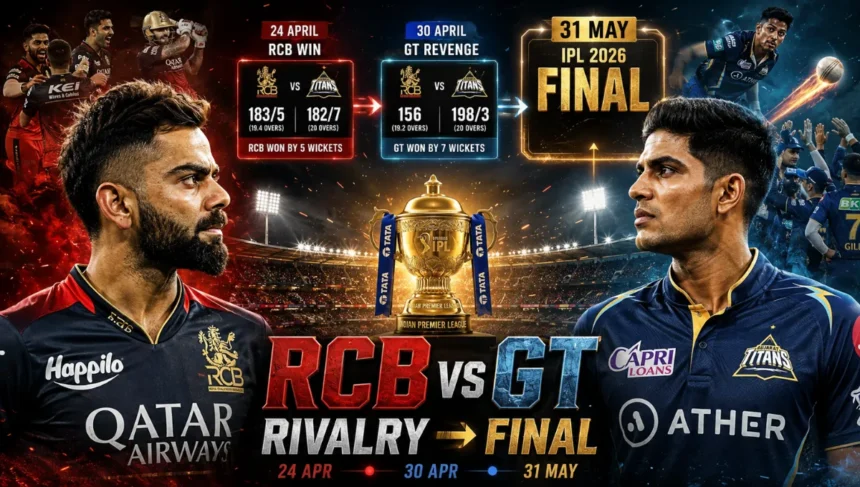
On 24 April 2026, Royal Challengers Bengaluru defeated Gujarat Titans in a close run chase. Six days later, Gujarat answered with a convincing win of their own. At that stage, the rivalry looked evenly balanced. By 31 May, however, the same two sides were facing each other again, this time with the IPL 2026 trophy on the line.
Read Also: Sikkim vs Mumbai Cricket Team – Match Preview, Stats, Squads & Analysis
Looking at only the four scorecards misses the bigger picture. The interesting part is how the rivalry changed from one game to the next. RCB and GT went from trading close league wins to meeting in the playoffs, where RCB completely shifted the balance of power.
RCB vs GT IPL 2026 Timeline at a Glance
| Date | Match | Result | Why It Mattered |
|---|---|---|---|
| 24 April 2026 | Match 34, Bengaluru | RCB won by 5 wickets | A tight chase continued the rivalry’s pattern |
| 30 April 2026 | Match 42, Ahmedabad | GT won by 4 wickets | GT exposed weaknesses in RCB’s middle order |
| 26 May 2026 | Qualifier 1, Dharamsala | RCB won by 92 runs | RCB broke the chasing-side trend with a huge total |
| 31 May 2026 | Final, Ahmedabad | RCB won by 5 wickets | RCB claimed the IPL 2026 championship |
Overall record: RCB won three of the four IPL 2026 meetings, including both playoff encounters.
Why the Full Timeline Matters
A match report tells you what happened on one day. A proper timeline connects those individual results and shows how one game influenced the next.
That matters particularly here because the rivalry underwent a major change. GT won the second league meeting convincingly, but RCB returned in the playoffs with a completely different level of performance. The Qualifier 1 win changed the narrative, and the final confirmed that the shift was real.
24 April 2026: Match 34 – RCB Take the First Advantage
The first meeting took place at the M. Chinnaswamy Stadium in Bengaluru. Gujarat Titans made 205/3, with Sai Sudharsan producing a century to give the visitors a formidable total.
RCB responded with 206/5 in 18.5 overs. Virat Kohli scored 81 from 44 deliveries, providing the foundation for the chase after surviving an early chance. Krunal Pandya then finished the job with a boundary late in the innings.
Why was this result significant? It continued a remarkable trend between the two sides: the team batting second had won seven consecutive meetings before this game. That pattern would become one of the defining features of the rivalry before eventually being destroyed in Qualifier 1.
RCB’s chase also revealed a small warning sign. Although the target was successfully reached, five wickets were lost. The batting lineup had won, but it had not dominated the chase from start to finish.
That vulnerability became much more obvious in the next meeting.
30 April 2026: Match 42 – Gujarat Titans Strike Back
Only six days later, the teams met again, this time at Narendra Modi Stadium in Ahmedabad.
The contest was far less competitive. RCB were dismissed for just 155, allowing Gujarat Titans to complete the chase at 158/6 in only 15.5 overs.
Shubman Gill immediately put pressure on the RCB attack, while Jason Holder, introduced as an Impact Player, helped finish the chase. Holder also produced an important catch and was named Player of the Match.
The result was more significant than simply levelling the season series.
RCB captain Rajat Patidar later acknowledged that his side had lost too many wickets through the middle overs, leaving them under pressure. That exposed a weakness GT had been able to exploit after seeing RCB’s approach just six days earlier.
The short turnaround was important. When two teams meet again within a week, neither side has much opportunity for major personnel changes. Tactical adjustments, however, can happen quickly. GT appeared to have identified where RCB’s batting was vulnerable and attacked that area effectively.
At this point, GT appeared to have the upper hand.
26 May 2026: Qualifier 1 – RCB Change Everything
The next meeting came almost four weeks later, but the circumstances were completely different. RCB and GT now met in Qualifier 1 at HPCA Stadium, Dharamsala, with a place in the IPL final at stake.
RCB did not simply win. They dismantled the pattern that had defined the earlier meetings.
Result: RCB defeated GT by 92 runs.
Royal Challengers Bengaluru: 254/5 in 20 Overs
| Batter | Runs | Balls | Sixes | Contribution |
|---|---|---|---|---|
| Rajat Patidar (c) | 93* | 33 | 9 | Match-winning innings |
| Virat Kohli | 43 | 25 | 1 | Built the platform |
| Devdutt Padikkal | 30 | 19 | 0 | Fast supporting knock |
Read Also: Mumbai Indians vs Sunrisers Hyderabad Match Scorecard
Gujarat Titans: 162 All Out in 19.3 Overs
GT’s chase quickly fell apart. Sai Sudharsan, Shubman Gill and Jos Buttler were all dismissed during the powerplay, leaving Gujarat under enormous pressure.
Rahul Tewatia fought back with 68 from 43 balls, but the target had already become too large to realistically chase.
The Record-Breaking Turning Point
The biggest story from Qualifier 1 was RCB’s first-innings assault.
Rajat Patidar smashed 93 from only 33 deliveries, including nine sixes, as RCB reached 254/5. The total was the highest in IPL playoff history at that point. [VERIFY]
This innings did more than produce a huge score. It removed the chasing advantage that had dominated previous meetings between these sides.
Before Qualifier 1, every previous RCB-GT encounter in the relevant streak had been won by the side batting second. RCB responded by making the chase almost impossible.
That is the tactical lesson from this match. Instead of trying to preserve wickets and leave themselves a manageable finish, RCB attacked aggressively enough to take the chase out of GT’s hands.
Key Player Performances in Qualifier 1
- Rajat Patidar – 93 off 33:* His innings arrived in the biggest RCB-GT match of the season and completely changed the shape of the contest.
- Sai Sudharsan, Shubman Gill and Jos Buttler: Their early dismissals put GT on the back foot before the chase had properly developed.
- Rahul Tewatia – 68 off 43: Tewatia’s innings prevented an even larger defeat and provided the only sustained resistance during GT’s chase.
- Virat Kohli – 43 off 25: Kohli helped RCB establish the platform before Patidar accelerated the scoring.
The important point was not just individual brilliance. RCB’s huge total forced GT’s batting order into high-risk cricket much earlier than it wanted.
31 May 2026: The Final – Kohli Finishes the Job
Five days after Qualifier 1, RCB and GT met again, this time at Narendra Modi Stadium in Ahmedabad.
RCB won the toss and chose to field.
Final result: RCB won by five wickets with 12 balls remaining and became IPL 2026 champions.
Gujarat Titans: 155/8 in 20 Overs
GT suffered another difficult start.
Their wickets fell at:
- 22/1 – Shubman Gill, 2.2 overs
- 26/2 – Sai Sudharsan, 3.4 overs
- 55/3 – Nishant Sindhu, 7.6 overs
- 73/4 – Jos Buttler, 12.1 overs
- 99/5 – Arshad Khan, 14.1 overs
Washington Sundar remained unbeaten on 50, helping Gujarat recover from the early damage and reach 155/8.
Royal Challengers Bengaluru: 161/5 in 18 Overs
RCB’s chase was controlled by Virat Kohli, who stayed at the crease throughout the innings and finished unbeaten on 75 from 42 balls.
That performance gave RCB the final push they needed to turn their Qualifier 1 victory into a championship.
How the Earlier Matches Led to the Final
Treating the final as an isolated game hides an important detail.
GT’s top order again collapsed early. Their wickets fell at 22/1, 26/2 and 55/3, remarkably similar to the pressure RCB had created during Qualifier 1 only five days earlier.
The difference was that this time RCB were playing for the trophy.
The five-day gap between Qualifier 1 and the final also mattered. RCB’s bowling strategy appeared to carry forward successfully, while GT could not find a solution for its vulnerable top order quickly enough.
The result was a familiar pattern: Gujarat needed its middle order to repair another difficult start, while RCB’s chase was guided by one of the most experienced batters in the competition.
Final Player Performance Highlights
- Virat Kohli – 75 off 42:* Kohli produced another defining performance in the rivalry. He had already top-scored with 81 in the opening meeting and finished the season’s final encounter unbeaten.
- Washington Sundar – 50:* His half-century gave GT a fighting total after the early wickets, but it was not enough.
- Rasikh Salam – 3/27: He recorded the best bowling figures in the final and played an important role in restricting GT.
- RCB’s bowling unit: The improvement from the earlier league meetings to the knockout stage was one of the biggest changes visible across the timeline.
A useful way to judge a T20 team’s progress is to see who delivers when the stakes rise. RCB’s bowlers produced their strongest impact when the season mattered most.
RCB vs GT: How the Power Shifted
| Stage | Advantage | Reason |
|---|---|---|
| Match 34, 24 April | RCB, narrowly | Won a close chase but lost five wickets |
| Match 42, 30 April | GT, clearly | Exploited RCB’s middle-order weakness |
| Qualifier 1, 26 May | RCB, decisively | Posted 254/5 and won by 92 runs |
| Final, 31 May | RCB, decisively | Repeated the pressure and won the title |
Read Also: Royal Challengers Bengaluru vs Gujarat Titans Stats
The broader story is that RCB’s transformation was not driven only by their famous batting names. Their bowling improvement became increasingly important once the tournament entered the knockout phase.
Between Match 42 and Qualifier 1, RCB had time to assess what had gone wrong and make tactical improvements. Those changes were visible immediately in Dharamsala and remained effective in the final.
What the RCB-GT Timeline Reveals About T20 Momentum
The biggest lesson from these four matches is simple: T20 momentum can change quickly, but the reasons behind that change are usually visible when matches are studied together.
GT’s victory on 30 April looked convincing. It suggested that Gujarat had figured out how to pressure RCB’s batting lineup. But that advantage did not survive the month-long gap before Qualifier 1.
RCB returned with a far more effective overall game plan. Their massive first-innings score removed the chasing advantage, while their bowling attack then exposed GT’s top order.
For teams and analysts, this is why one result should never be treated as a permanent verdict. The more useful question is what changed between two meetings.
RCB clearly used the gap before Qualifier 1 to address weaknesses exposed by GT. The result was a 92-run victory and a place in the final.
GT, meanwhile, struggled to solve the problems that had appeared again in the knockout meeting. By the time the final arrived, RCB had established control of the rivalry.
Major Highlights and Records
- The team batting second had dominated the earlier RCB-GT meetings before Qualifier 1 ended that sequence.
- RCB scored 254/5 in Qualifier 1, the highest IPL playoff total at that stage. [VERIFY]
- Rajat Patidar’s 93 from 33 balls* included nine sixes and became the most explosive individual innings in this 2026 rivalry.
- Virat Kohli made a major impact at both ends of the timeline, scoring 81 in the first meeting and remaining unbeaten on 75 in the final.
- RCB completed the IPL 2026 season by defeating GT in the final and claiming the championship. [VERIFY]
- RCB’s three wins from four meetings gave them clear overall control of the season series.
Frequently Asked Questions
Q1. How many times did RCB play Gujarat Titans in IPL 2026?
Answer: RCB and Gujarat Titans met four times during the IPL 2026 timeline: on 24 April, 30 April, 26 May and 31 May. RCB won three matches, while GT won once. The two final meetings were Qualifier 1 and the IPL final.
Q2. When did RCB end GT’s chasing advantage?
Answer: RCB ended the chasing-side pattern in Qualifier 1 on 26 May 2026. They posted 254/5 in Dharamsala, leaving GT with a huge target and eventually winning by 92 runs.
Q3. What was the highest score in the RCB vs GT IPL 2026 matches?
Answer: RCB’s 254/5 in Qualifier 1 was the highest team total across their four meetings in IPL 2026. It also stood as the highest IPL playoff score at that point. [VERIFY]
Q4. What happened in the IPL 2026 final between RCB and GT?
Answer: Gujarat Titans made 155/8 after losing several early wickets. RCB chased the target successfully, reaching 161/5 in 18 overs. Virat Kohli remained unbeaten on 75 from 42 balls as RCB won by five wickets and claimed the title.
Q5. Did Virat Kohli perform well throughout the RCB-GT timeline?
Answer: Yes. Kohli made 81 runs in the first meeting on 24 April and later finished unbeaten on 75 in the final on 31 May. His performances at both ends of the timeline made him one of RCB’s most influential players in the rivalry.