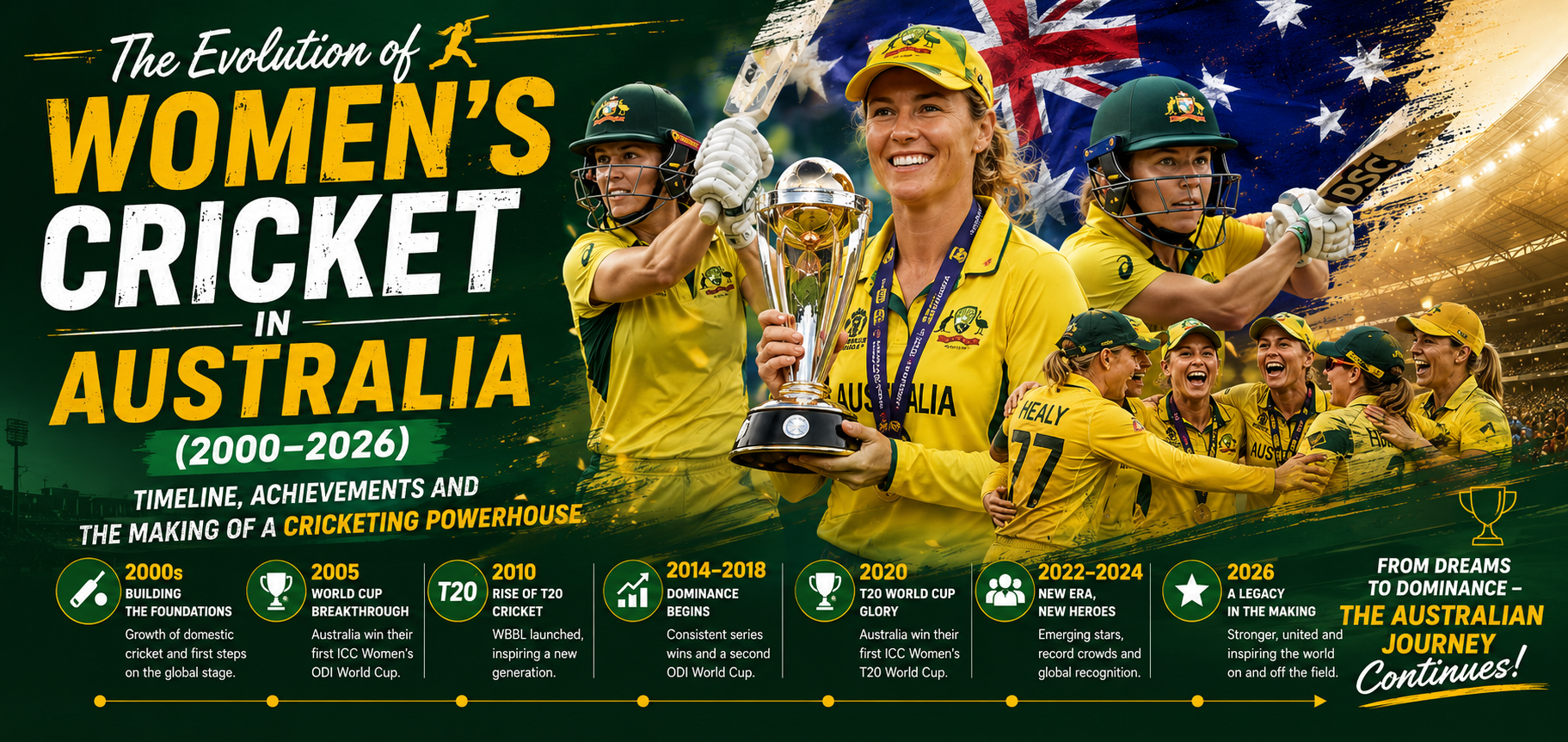
In modern sport, At the beginning of the 21st century, Australia’s women were already among the world’s strongest teams, but the game itself remained largely semi-professional. Players balanced cricket with work or study, television coverage was limited, and commercial opportunities were scarce.
Twenty-six years later, Australia has become the benchmark for excellence in women’s cricket. The national team has dominated ICC tournaments, domestic competitions have become fully professional, attendance records have been broken, and Australian players have become global stars in franchise leagues around the world.
The journey from 2000 to 2026 is not merely a story of winning trophies—it is a story of vision, investment, talent development, and sustained excellence.
Timeline: The Evolution of Women’s Cricket in Australia (2000–2026)
| Year | Milestone |
| 2000 | Australia won the ICC Women’s Cricket World Cup in New Zealand. |
| 2003 | Women’s Cricket Australia merged with the Australian Cricket Board to form a unified governing structure under Cricket Australia. |
| 2005 | Australia won another ICC Women’s Cricket World Cup, beginning a new era of dominance. |
| 2007 | Ellyse Perry made her international debut at just 16 years of age. |
| 2009 | Australia hosted and won the inaugural ICC Women’s T20 World Cup. |
| 2010 | Australia successfully defended the ICC Women’s T20 World Cup. |
| 2013 | Australia regained the ODI World Cup by defeating the West Indies in the final. |
| 2015 | The Women’s Big Bash League (WBBL) was launched, transforming the domestic game. |
| 2017 | Landmark pay agreement significantly improved salaries and professional conditions for women cricketers. |
| 2018 | Australia won another ICC Women’s T20 World Cup. |
| 2020 | Australia won the T20 World Cup before a record crowd of 86,174 at the Melbourne Cricket Ground. |
| 2022 | Australia won the ICC Women’s Cricket World Cup and Commonwealth Games gold medal. |
| 2023 | Australia secured a sixth ICC Women’s T20 World Cup title. |
| 2024 | Australia reached the semi-finals of the ICC Women’s T20 World Cup but did not defend the title. |
| 2025 | Australia exited the ICC Women’s ODI World Cup in the semi-finals, ending another title defence. |
| 2026 | Australia won a record seventh ICC Women’s T20 World Cup, ushering in a successful new era under captain Sophie Molineux. |
The Early Years (2000–2004): Building on an Established Legacy
Australia entered the new millennium as one of the strongest women’s teams in the world. Led by captain Belinda Clark, they captured the 2000 ICC Women’s Cricket World Cup by defeating New Zealand in the final.
Although Australia enjoyed on-field success, women’s cricket was still far from professional. Most players earned modest match payments, training resources were limited compared to the men’s game, and media coverage remained minimal.
A significant administrative milestone came in 2003, when Women’s Cricket Australia merged with the Australian Cricket Board (now Cricket Australia). This integration brought women’s cricket under the same governing body as the men’s game, paving the way for greater investment and long-term strategic planning.
A Dynasty Takes Shape (2005–2014)
Between 2005 and 2014, Australia established one of the greatest dynasties in cricket history.
The team won the 2005 Women’s ODI World Cup and then adapted brilliantly to the growing popularity of Twenty20 cricket.
During this period, players such as:
- Karen Rolton
- Lisa Sthalekar
- Cathryn Fitzpatrick
- Alex Blackwell
- Shelley Nitschke
- Jodie Fields
were gradually joined by an exciting new generation featuring Ellyse Perry, Jess Jonassen, Meg Lanning, and Alyssa Healy.
Australia also won the 2010, 2012, and 2014 ICC Women’s T20 World Cups, establishing themselves as the leading force in the shortest format.
The Women’s Big Bash League Revolution
Perhaps no single development changed Australian women’s cricket more than the launch of the Women’s Big Bash League (WBBL) in 2015.
Unlike previous domestic competitions, the WBBL offered:
- Professional coaching environments
- Live television coverage
- International overseas players
- City-based franchises
- Greater commercial opportunities
Young cricketers now had a clear pathway from junior cricket to state cricket, the WBBL, and eventually the Australian national team.
The league also became one of the world’s premier women’s T20 competitions, attracting elite players from every major cricket nation.
Professionalism Changes Everything
Australia’s success has not been based solely on talent.
Cricket Australia invested heavily in:
- Central contracts
- Sports science
- High-performance coaching
- Strength and conditioning
- Mental skills programs
- Grassroots participation
A landmark 2017 Memorandum of Understanding (MOU) significantly increased player salaries and improved working conditions, allowing many women cricketers to become full-time professionals.
The benefits of that investment became increasingly evident over the following decade.
Australia’s Golden Generation
Few teams in cricket history have possessed the depth Australia has enjoyed since the late 2010s.
Some of the defining players include:
| Player | Primary Role | Major Contribution |
| Meg Lanning | Batter | One of Australia’s most successful captains |
| Ellyse Perry | All-rounder | Widely regarded as one of the greatest all-rounders in cricket history |
| Alyssa Healy | Wicketkeeper-Batter | Match-winning opener in ICC finals |
| Beth Mooney | Batter | Consistent performer in ICC tournaments |
| Ashleigh Gardner | All-rounder | Match-winning off-spin and power-hitting |
| Jess Jonassen | Spin Bowler | Key wicket-taker across formats |
| Megan Schutt | Fast Bowler | Australia’s leading pace bowler of the modern era |
| Annabel Sutherland | All-rounder | Emerging star across formats |
| Tahlia McGrath | All-rounder | Versatile contributor with bat and ball |
The seamless transition between generations has been one of Australia’s greatest strengths.
ICC Tournament Success (2000–2026)
Australia’s record in major ICC tournaments during this period is unmatched.
| Tournament | Titles Won (2000–2026) |
| ICC Women’s ODI World Cup | 4 (2000, 2005, 2013, 2022) |
| ICC Women’s T20 World Cup | 7 (2010, 2012, 2014, 2018, 2020, 2023, 2026) |
| Commonwealth Games | Gold Medal (2022) |
The 2020 T20 World Cup Final at the Melbourne Cricket Ground remains one of the defining moments in women’s sport, with 86,174 spectators watching Australia defeat India—a record attendance for a women’s cricket match.
The New Era (2024–2026)
Every dominant team eventually faces transition, and Australia entered a new phase following the retirement or reduced roles of several senior players.
Despite semi-final exits at the 2024 Women’s T20 World Cup and the 2025 Women’s ODI World Cup, Australia responded emphatically in 2026, winning a record-extending seventh Women’s T20 World Cup under new captain Sophie Molineux. The campaign showcased the emergence of players such as Phoebe Litchfield and Georgia Voll alongside experienced stars Beth Mooney, Ellyse Perry, and Ashleigh Gardner.
Why Australia Has Stayed Ahead
Australia’s sustained success rests on several pillars:
- A strong domestic structure through the WNCL and WBBL.
- Long-term investment by Cricket Australia.
- Elite coaching and sports science.
- Consistent talent identification from junior cricket.
- A winning culture built over multiple generations.
- Opportunities for players to compete in global franchise leagues.
Unlike many nations that rely on a handful of stars, Australia has repeatedly produced world-class replacements when senior players retire.
Key Achievements (2000–2026)
| Achievement | Details |
| ODI World Cups | 4 titles (2000, 2005, 2013, 2022) |
| T20 World Cups | 7 titles (2010, 2012, 2014, 2018, 2020, 2023, 2026 |
| Commonwealth Games | Gold medal (2022) |
| Major Domestic Innovation | Launch of the Women’s Big Bash League (2015) |
| Governance Milestone | Integration into Cricket Australia (2003) |
| Professional Milestone | Landmark player-pay agreement (2017) |
| Record Crowd | 86,174 at the 2020 Women’s T20 World Cup Final |
Conclusion
From a talented but largely semi-professional side in 2000 to a global powerhouse by 2026, Australia’s journey has reshaped women’s cricket. Administrative reforms, investment in domestic competitions, improved player welfare, and an extraordinary succession of elite cricketers have combined to create one of the most successful sporting programs in history.
While other nations continue to close the gap, Australia remains the benchmark against which every women’s cricket team is measured. Their evolution over the past quarter-century is not simply a collection of titles—it is a blueprint for building sustained excellence in women’s sport.