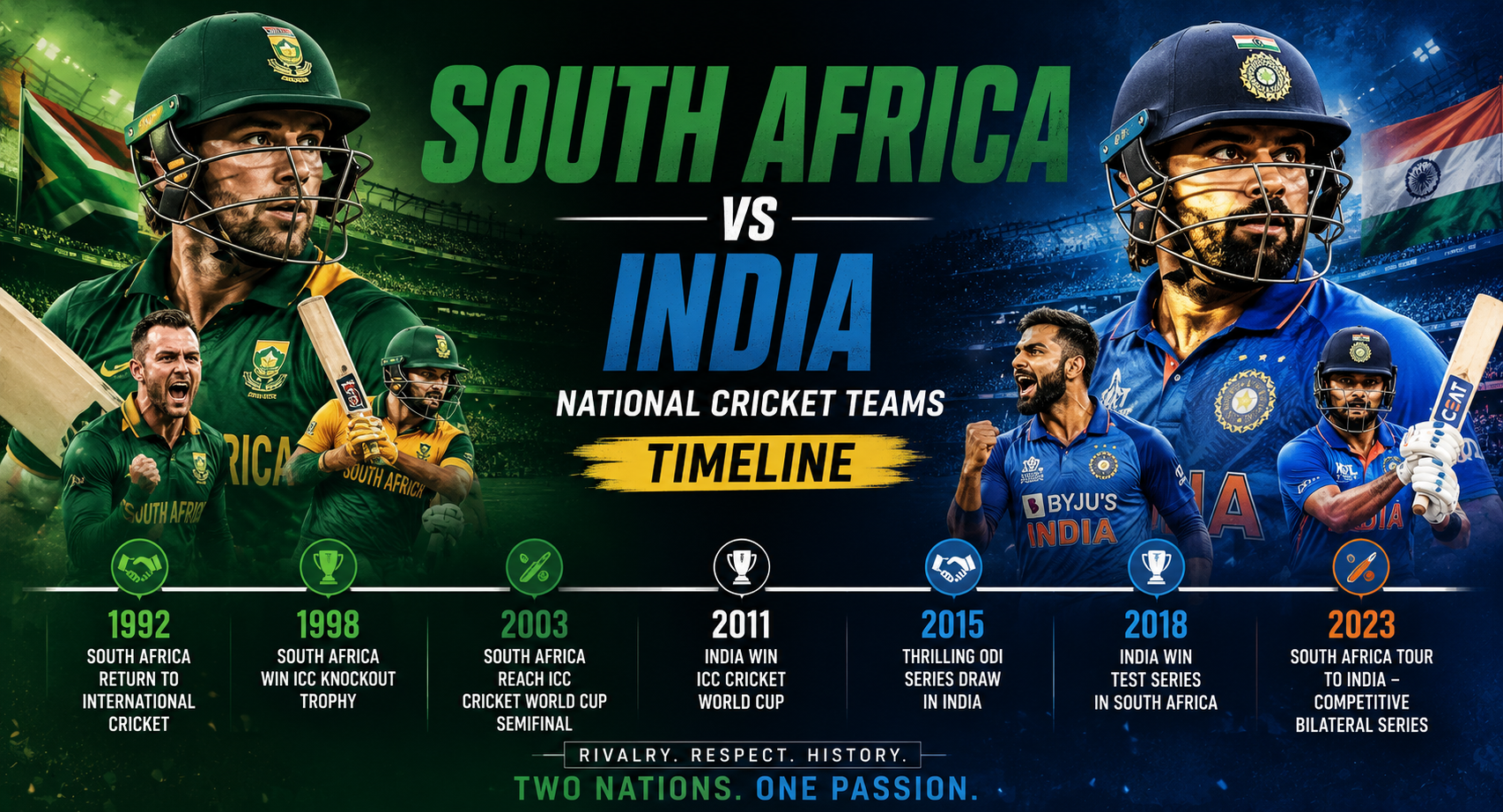
Few international cricket rivalries carry the historical weight, emotional intensity, and statistical fascination of the South Africa national cricket team vs India national cricket team contest. Born out of South Africa’s readmission to international cricket in 1991 after the apartheid-era isolation, this rivalry has spanned 35 years of elite cricket across three formats — producing Test series of uncommon drama, ODI classics that shaped World Cup histories, and T20I encounters that have progressively tilted India’s way with statistical authority that would have seemed impossible just a decade ago. Cricket fans across India — watching on Star Sports and JioHotstar — and the South African diaspora in the UAE have followed every chapter of this evolving rivalry: from Sreesanth’s maiden fifer in Johannesburg, to Tendulkar’s artistry against Donald and Pollock, to Kohli’s extraordinary rescue act in the 2024 T20 World Cup final in Barbados, to Tilak Varma and Sanju Samson’s record-demolishing 283/1 at The Wanderers. This comprehensive South Africa national cricket team vs India national cricket team timeline covers every significant era, format, match, and player who has shaped one of international cricket’s most compelling rivalries.
Rivalry Overview & Overall Head-to-Head Records
The cricket rivalry between India and South Africa has been one of the most competitive in international cricket since South Africa’s readmission in 1991. Over the years, both teams have produced thrilling contests across all formats, creating a fascinating rivalry history. From memorable Test battles to high-scoring ODI and T20 clashes, both sides have enjoyed periods of dominance and unforgettable performances.
As per the latest stats and records from 1991 to 2025, the Indian Cricket Team and South Africa Cricket Team have played a total of 169 matches against each other, across all three formats of the game. In the Test format, both of the nations have faced each other in 44 matches, with 18 wins for South Africa and 16 wins for India, and 10 ending without any result. In ODI cricket, IND vs SA head to head also lies in the hands of South Africa, with 51 matches out of 94. Whereas in the T20I format, the Indian Cricket Team leads the chart with 18 victories out of 31 matches.
The rivalry’s defining characteristic is its format-specific nature — each format telling a completely different story about which team holds the upper hand. South Africa’s Test and ODI dominance, built on quality seam bowling in their home conditions and clinical batting depth, contrasts sharply with India’s T20I authority, built on a generation of power-hitters who have taken the shortest format to an entirely new dimension. The contest between these two philosophies — South Africa’s traditional cricket intelligence versus India’s modern T20 revolution — makes every series between them a genuinely unpredictable event.
India’s top run-scorer in this rivalry is Sachin Tendulkar with 1,741 runs, while India’s top wicket-taker is Anil Kumble with 84 wickets across all formats.
Read More: Sachin Tendulkar — Complete International Career Stats, Records & Highlights
Era 1 — Readmission & Early Encounters (1991–1999): Donald, Tendulkar & The First Duels
November 1991 — The First ODI: India Win a Rain-Affected Match
India and South Africa’s first international encounter came on November 10, 1991, in a rain-affected ODI in Calcutta — a match that carried historical significance far beyond its cricket. South Africa’s return to international competition after more than two decades of apartheid-enforced isolation was greeted with emotional scenes across the cricketing world, and India’s hosting of their first fixture gave the occasion additional symbolism. The first ODI between the two sides was played in 1991, when India won the rain-affected match by three wickets. Sachin Tendulkar scored 62 and took 1/27 while Allan Donald claimed 5/29 — a statistical introduction to two of the rivalr’s defining individual duels that would play out across the following decade.
Allan Donald’s 5/29 was the first statement of intent from a South African pace bowling attack that would become one of the most feared in world cricket across the 1990s. Donald’s steep bounce, generated from a high release point and delivered at genuine pace, troubled Indian batsmen in conditions far removed from the flat subcontinental pitches that formed their cricket education.
1992 World Cup — Kallis’s Rescue Act
In the 1999 World Cup match, Sourav Ganguly’s 97 and Rahul Dravid’s 54 took India to 253/5. South Africa had a poor start, but Jacques Kallis’s 96 saw them through with four wickets to spare. Kallis’s 96 in that fixture — combining correct defensive technique with calculated aggression that prevented India’s bowling from building sustained pressure — introduced the cricketing world to the all-rounder who would become India’s most significant individual opponent across nearly two decades of competition.
1996–97 — Rahul Dravid’s Johannesburg Masterclass
India’s 1996–97 tour of South Africa produced one of the great individual batting performances from an Indian batsman on South African soil. On the occasion of the third test of the 1996–97 tour at Johannesburg, Rahul Dravid anchored down and added 54 runs with Sachin Tendulkar and 145 runs with Sourav Ganguly. Dravid himself hit a wonderful 148 runs in 362 balls with 21 fours. He faced bowlers like Allan Donald, Shaun Pollock, Brian McMillan and Lance Klusener at their peak. Even Donald praised the guts and technique of Dravid on a considerably fast Joburg pitch.
Dravid’s 148 — scored on a pitch that offered consistent bounce and movement to bowlers of Donald’s exceptional pace — remains one of the most technically accomplished innings by any Indian batsman in South African conditions. His footwork against Donald’s short ball, his placement through the off-side against Pollock’s seam movement, and his patience across 362 balls against sustained high-quality bowling established a template for batting in South Africa that subsequent Indian generations aspired to replicate.
Era 2 — The Golden Generation Clash (2000–2008): Kallis, Dravid & India’s First Win in SA
The Giants at Their Peak
The early 2000s produced the greatest concentration of batting talent these two nations have ever simultaneously fielded. India’s “Fab Four” — Tendulkar, Dravid, Ganguly, and Laxman — faced a South African bowling attack of Donald, Pollock, Ntini, and the emerging Kallis, while South Africa’s batting depth — Herschelle Gibbs, Graeme Smith, Hashim Amla, and Kallis — confronted Anil Kumble and Zaheer Khan at their most penetrative. The bilateral encounters of this period rank among the finest Test cricket produced in any format anywhere in the world.
South Africa’s home fortress during this period — particularly the Wanderers in Johannesburg, Newlands in Cape Town, and Centurion — proved consistently hostile for Indian batsmen. The combination of bounce from hard South African pitches, lateral movement from Pollock and Donald in the first session, and the psychological weight of attempting to score against a team playing in their strongest conditions produced a pattern of Indian first-innings collapses that undermined otherwise competitive touring performances.
December 2006 — India’s First Test Victory in South Africa
It took 15 years and three winless tours for India to finally register their first win on South African soil. The Rahul Dravid-led team defeated South Africa by 123 runs to take a 1-0 lead in the series.
Graeme Smith’s South Africa were firm favourites to win the three-match Test series in 2006. India, led by Rahul Dravid, had already lost the ODI series, which preceded the first Test in Johannesburg, 4-0. India had never won a Test match in South Africa, although they had drawn five in their previous nine attempts in South Africa.
The match marked the comeback of former Indian captain Sourav Ganguly, who played a crucial innings of 51, pushing India’s total to 249. Then, Sreesanth (5/40) bowled one of the best spells ever by an Indian bowler overseas to knock over South Africa for 84.
Sreesanth’s fiery spell (5/40 and 3/59) in the 2006 Johannesburg Test led to India beating the Proteas by 123 runs — their first Test win in South Africa. Sreesanth’s five-wicket haul — achieved through reverse swing at high pace on a Wanderers surface that he exploited with exceptional skill — produced scalps of Graeme Smith, Hashim Amla, and Jacques Kallis cheaply, a first-innings total of 84 that gifted India a match advantage they never relinquished. The victory ended a 15-year wait and fundamentally shifted the psychological balance of the rivalry’s Test chapter.
Era 3 — World No. 1 Battles (2009–2015): Steyn’s Dominance vs India’s Home Fortress
2010 — Dale Steyn Announces Global Supremacy
The 1st Test at Vidarbha Cricket Association Stadium, Nagpur on February 6–9, 2010 saw South Africa win by an innings and 6 runs (SA 558/6d; Ind 233 and 319 f/o). Dale Steyn’s bowling in the 2010 series — a combination of raw pace, late swing, and a bouncer of exceptional accuracy that he bowled at batsmen’s rib cages with disturbing precision — established him as the finest fast bowler in the world at that moment. India’s win at Durban in 2010 came on the back of a collective bowling effort by Zaheer Khan, Harbhajan, Sreesanth and Ishant Sharma, with the series drawn 1-1 — India’s best away Test series result in South Africa to that point.
2011 — Cape Town, Tendulkar’s Artistry & The Series Decider
India toured South Africa in the last month of 2010 for a full tour that comprised of 3 Tests, 5 ODIs and a T20 international. India started the tour on a low after a crushing defeat by an innings and 25 runs against the hosts in the 1st Test at the Centurion. It was the fierce bowling duo of Dale Steyn and Morne Morkel that was hard to be tackled by the Indian batsmen.
The 3rd Test at Cape Town — a series decider with both teams level at 1-1 — produced some of the finest Test cricket in the rivalry’s history. Kallis’s century in South Africa’s first innings, the tactical battle between Dhoni’s field placements and Steyn’s disciplined line, and the Cape Town conditions that offered morning movement before settling into batting-friendly afternoon cricket created a contest of genuine quality. The match ended in a draw, with Tendulkar’s batting in India’s second innings — Sachin Tendulkar walked in and played one of his best innings — earning the praise of every cricketing observer fortunate enough to witness it.
2013 — Johannesburg: The Post-Tendulkar Era Begins
It was the first Test match that India was playing in the post-Tendulkar era. Amidst all the euphoria and emotions around Sachin Tendulkar’s farewell, India was up against a rampaging Dale Steyn on a green Wanderers pitch. Virat Kohli in his first innings at No.4 did not let India miss Tendulkar much with a dominant 119 on the first day pushing India’s total to 280. Zaheer and Ishant led the charge for India taking four wickets apiece, limiting South Africa to 244 all out. In the second innings, Pujara (153) and Kohli (96) helped India set South Africa an improbable 458 runs to win. When Jacques Kallis got out with South Africa precariously placed at 4/197, an Indian win looked imminent. However, Faf du Plessis (134) and AB de Villiers’ (105) marathon partnership of 205 helped regroup South Africa.
The Johannesburg Test of 2013 encapsulated the rivalry in a single match — Kohli’s emergence as India’s next batting cornerstone, Pujara’s technical excellence against world-class pace bowling, and then Faf and de Villiers’ determination to deny India a victory that had seemed inevitable. The match ended in a draw, a result that satisfied neither camp but showcased the extraordinary talent on both sides.
2015 — India’s Comprehensive Home Dominance
India defeated South Africa convincingly in 2015 by 3-0 in a four-match Test series — a comprehensive home sweep achieved through India’s superior spin bowling resources on turning subcontinental pitches. Ravichandran Ashwin and Ravindra Jadeja’s complementary left-arm and right-arm wrist-spin combination proved unplayable for South Africa’s batsmen, who struggled to both read the turn and maintain technique against sustained pressure across five days.
The 2015 series in India included a 337-run win at Delhi — India 334 and 267/5d; SA 121 and 143 — one of the most one-sided Test results in the rivalry’s history, South Africa’s batting collapsing twice against a combination of spin and variable bounce that they had no tactical answer to.
Read More: India vs South Africa Test Series History — All Results, Scorecards & Highlights
Era 4 — Kohli’s Era & South Africa’s Test Superiority (2016–2021)
2018 — South Africa’s Home Series Dominance
India’s 2018 Test tour of South Africa — Kohli’s first full tour as Test captain — produced one of the rivalry’s most dramatic series, with South Africa winning the three-match contest 2-1 in a series that confirmed both teams’ format-specific strengths.
Kagiso Rabada’s emergence as South Africa’s new pace spearhead — his steep bounce extracting edges even from batsmen of Kohli’s class, his yorker executed at 145+ kph to dismiss lower-order batsmen with clinical precision — gave the Proteas a genuinely world-class match-winner comparable to Steyn at his peak. India’s own bowling attack, led by Bumrah and Shami, dismissed South Africa for under 200 in multiple innings but failed to capitalise consistently through batting collapses on SENA pitches.
2019 — India’s Second Consecutive 3-0 Home Sweep
India followed their 2015 home sweep with another 3-0 clean sweep in 2019 at home against South Africa — two consecutive home series victories without conceding a single Test reflecting the complete dominance India had established in their own conditions through this period. India’s batting depth — capable of posting 300-plus in the first innings consistently — and their spin bowling combination proved insurmountable for South Africa on Indian pitches.
2021 — South Africa Win Away Test Series in India
South Africa’s 2021–22 tour of South Africa produced one of the rivalry’s most significant results. Despite losing the first Test, India fought back to level the series — and the eventual outcome confirmed that away Test victories in this rivalry remain the most coveted achievements for both nations’ Test programmes.
Era 5 — T20 World Cup Glory & India’s Modern Dominance (2022–2025)
June 29, 2024 — The T20 World Cup Final: India’s Greatest ICC Moment
The 2024 ICC T20 World Cup final at Kensington Oval, Bridgetown, Barbados stands as the most consequential single match in this rivalry’s entire history — a contest where India ended an 11-year wait for an ICC title and simultaneously delivered South Africa their most heartbreaking near-miss in a tournament they had never previously won.
India ended their 13-year wait for an ICC Cricket World Cup trophy when they beat South Africa by seven runs to lift the ICC Men’s T20 World Cup 2024 in a thrilling final at the Kensington Oval in Bridgetown, Barbados. South Africa were left heartbroken after coming close to winning their maiden world title but were eventually unable to get over the line against a strong Indian bowling lineup in a match that swayed from end to end.
India 176/7 in 20 overs (Virat Kohli 76, Axar Patel 47; Keshav Maharaj 2/23) beat South Africa 169/8 in 20 overs (Heinrich Klaasen 52; Hardik Pandya 3/20) by seven runs.
Chasing 177 to win, the Proteas seemed in control when they needed 71 runs off 45 balls with six wickets in hand and the pair of Quinton de Kock and Heinrich Klaasen leading their chase. India, however, had not given up on their chance. All-rounder Hardik Pandya stepped up to remove Klaasen in his first over and followed it up with the crucial wicket of David Miller, courtesy of a stunning catch on the long off boundary by Suryakumar Yadav.
It then came down to 16 off 6 balls needed and the rain started to fall as Pandya came to bowl. Miller hit the full toss with all his power and then Suryakumar Yadav took the best catch of his career to dismiss Miller and put India’s one hand on the trophy.
Suryakumar’s catch — diving back toward the boundary, releasing the ball before it crossed the rope and catching it on re-entry in one instinctive movement — was the single most technically demanding fielding action seen in any ICC final. Its timing, arriving at the precise moment South Africa’s chase appeared alive, made it not merely a brilliant catch but the definitive turning point of a match that will define both teams’ cricket history.
Virat Kohli was named Player of the Match for scoring 76 runs. Following India’s victory, captain Sharma, Virat Kohli and Ravindra Jadeja announced their retirement from T20I cricket. Rahul Dravid’s tenure as India’s head coach came to an end after this tournament.
November 2024 — 283/1 at Johannesburg: T20I Records Shattered
The post-World Cup T20I series in South Africa produced one of the most devastating batting performances in the rivalry’s entire T20I history — a match that recontextualised what Indian T20 batting could achieve even without the Rohit-Kohli era stars.
The Indian men’s cricket team, led by centurions Tilak Varma and Sanju Samson, posted 283/1, its second highest score in the T20 Internationals (T20Is), to defeat South Africa by 135 runs and win the series 3-1 in Johannesburg. Tilak Varma scored a dazzling 120 off 47 balls while opener Sanju Samson contributed a blistering 109 off 56 balls. The left-right combo forged an unbeaten 210 runs partnership, the highest for any wicket in India’s T20 International history. India’s onslaught included a record-breaking 23 sixes, the most ever in a T20 International between two Full Member sides.
In reply, South Africa’s chase never took off after Arshdeep Singh (3/20) dealt the home team early blows. The Proteas were bowled out for 148 runs in 18.2 overs. The victory margin of 135 runs was India’s biggest over South Africa in the shortest format. India — fielding just four players from their World Cup-winning squad — continued to dismantle South Africa’s bowling attack with the same fearless aggression that had characterised their entire 2024 T20I season.
December 2025 — India Win T20I Series 3-1 Again
India defeated South Africa by 30 runs in the fifth and final T20 International to clinch the series 3-1 in Ahmedabad. India posted 231 for the loss of five wickets in 20 overs. Tilak Varma with 73 runs and Hardik Pandya with 63 made valuable contributions. Hardik smashed a fifty in just 16 balls, becoming the second-fastest Indian to reach the milestone. Chasing a target of 232 runs, the visitors were restricted to 201 for the loss of eight wickets. Varun Chakravarthy claimed a four-wicket haul and was adjudged Player of the Series.
Back-to-back T20I series victories over South Africa — in South Africa in November 2024 and then at home in December 2025 — confirmed India’s comprehensive supremacy in the format against the Proteas, with Tilak Varma’s consistent performances across both series establishing him as the rivalry’s defining batting figure of the mid-2020s.
Read More: India T20I Records 2024 — Most Sixes, Highest Totals & Series Results
Iconic Match Scorecards — Full Analysis
Match 1 — India’s First Test Win in South Africa (December 15–18, 2006, Johannesburg)
| Match Information | Details |
|---|---|
| Match | 1st Test, India tour of South Africa 2006–07 |
| Format | Test Cricket |
| Venue | The Wanderers Stadium, Johannesburg |
| Date | December 15–18, 2006 |
| Toss | South Africa won, elected to bat |
| Result | India won by 123 runs |
| Player of the Match | S Sreesanth (5/40 and 3/59) |
India 1st Innings: 249 | India 2nd Innings: 236
South Africa 1st Innings Batting (Key Scores)
| Batsman | Dismissal | Runs | Note |
|---|---|---|---|
| Graeme Smith (c) | b Sreesanth | — | Dismissed cheaply |
| Hashim Amla | b Sreesanth | — | Dismissed cheaply |
| Jacques Kallis | b Sreesanth | — | Dismissed cheaply |
| Ashwell Prince | — | 97 | Valiantly top-scored in 2nd innings |
South Africa 1st Innings Total: 84 all out
Sreesanth (5/40) bowled one of the best spells ever by an Indian bowler overseas to knock over South Africa for 84. India, with the help of VVS Laxman (73) could only manage 236 in the second innings leaving South Africa 401 runs to win. A valiant effort by Ashwell Prince (97) in the second innings was not enough as South Africa capitulated against the duo of Zaheer and Sreesanth who claimed three wickets each.
South Africa’s first-innings 84 remains their lowest total against India and one of the most dramatic collapses in the rivalry’s Test history. Sreesanth’s ability to reverse swing an older ball at genuine pace, combined with Anil Kumble’s sustained accuracy that prevented South Africa’s lower order from contributing, produced a first-innings deficit of 165 runs that decided the match despite Prince’s courageous resistance in the second innings.
Match 2 — T20 World Cup 2024 Final (June 29, 2024, Barbados)
| Match Information | Details |
|---|---|
| Match | ICC T20 World Cup 2024 Final |
| Format | T20I |
| Venue | Kensington Oval, Bridgetown, Barbados |
| Date | June 29, 2024 |
| Toss | India won, elected to bat |
| Result | India won by 7 runs |
| Player of the Match | Virat Kohli (76 off 59 balls) |
| Player of the Series | Jasprit Bumrah |
India Batting
| Batsman | Dismissal | Runs | Balls | 4s | 6s | SR |
|---|---|---|---|---|---|---|
| Rohit Sharma (c) | b Maharaj | — | — | — | — | — |
| Virat Kohli | b Nortje | 76 | 59 | — | — | 128.81 |
| Rishabh Pant | b Maharaj | — | — | — | — | — |
| Suryakumar Yadav | b Rabada | — | — | — | — | — |
| Axar Patel | run out | 47 | 31 | — | — | 151.61 |
| Shivam Dube | — | — | — | — | — | — |
| Hardik Pandya | — | — | — | — | — | — |
| Ravindra Jadeja | — | — | — | — | — | — |
Total: 176/7 (20 overs)
Fall of Wickets (India)
| Wicket | Score | Batsman | Over |
|---|---|---|---|
| 1st | 23/1 | Rohit Sharma | 1.4 |
| 2nd | 23/2 | Rishabh Pant | 1.6 |
| 3rd | 34/3 | Suryakumar Yadav | 4.3 |
| 4th | 106/4 | Axar Patel | 13.3 |
| 5th | 163/5 | Virat Kohli | 18.5 |
| 6th | 174/6 | Shivam Dube | 19.4 |
| 7th | 176/7 | Ravindra Jadeja | 19.6 |
South Africa Bowling
| Bowler | Overs | Runs | Wickets | Economy |
|---|---|---|---|---|
| Keshav Maharaj | 4 | 23 | 2 | 5.75 |
| Anrich Nortje | 4 | — | 2 | — |
| Marco Jansen | 4 | — | 1 | — |
| Kagiso Rabada | 4 | — | 1 | — |
| Tabraiz Shamsi | 4 | — | 0 | — |
South Africa Batting — The Chase
| Batsman | Dismissal | Runs | Balls | 4s | 6s | SR |
|---|---|---|---|---|---|---|
| Reeza Hendricks | b Bumrah | — | — | — | — | — |
| Quinton de Kock (wk) | — | 39 | — | — | — | — |
| Aiden Markram (c) | — | — | — | — | — | — |
| Tristan Stubbs | — | 31 | — | — | — | — |
| Heinrich Klaasen | b Pandya | 52 | — | — | — | — |
| David Miller | c Suryakumar b Pandya | 21 | 17 | 1 | 1 | 123.52 |
| Marco Jansen | b Bumrah | — | — | — | — | — |
| Kagiso Rabada | c Suryakumar b Pandya | 4 | 3 | 1 | 0 | 133.33 |
Total: 169/8 (20 overs)
India Bowling
| Bowler | Overs | Runs | Wickets | Economy |
|---|---|---|---|---|
| Jasprit Bumrah | 4 | 18 | 2 | 4.50 |
| Hardik Pandya | 4 | 20 | 3 | 5.00 |
| Arshdeep Singh | 4 | — | 2 | — |
| Kuldeep Yadav | 4 | — | 1 | — |
| Axar Patel | 4 | — | 0 | — |
Chasing 177, the Proteas seemed in control when they needed 71 runs off 45 balls with six wickets in hand with de Kock and Klaasen leading the chase. Klaasen’s 52 — played with the controlled aggression that makes him the most dangerous T20 finisher in South African cricket — appeared to be guiding the Proteas to an historic title. Then Bumrah’s dismissal of Marco Jansen — an inswinging delivery that crashed into the stumps off a perfect length — changed the match’s entire momentum.
Miller hit the full toss with all his power and then Suryakumar Yadav took the best catch of his career to dismiss Miller — a catch that combined exceptional anticipation, elastic body movement, and composure at the exact moment when South Africa needed one more boundary to genuinely threaten the target. Virat Kohli announces retirement from T20Is in the post-match presentation ceremony after he was named Player of the Match.
Match 3 — India’s 283/1 at The Wanderers (November 15, 2024)
| Match Information | Details |
|---|---|
| Match | 4th T20I, India tour of South Africa 2024–25 |
| Format | T20I |
| Venue | The Wanderers Stadium, Johannesburg |
| Date | November 15, 2024 |
| Toss | India won, elected to bat |
| Result | India won by 135 runs |
| Player of the Match | Tilak Varma (120* off 47 balls) |
India Batting
| Batsman | Dismissal | Runs | Balls | 4s | 6s | SR |
|---|---|---|---|---|---|---|
| Sanju Samson (wk) | not out | 109 | 56 | 6 | 9 | 194.64 |
| Abhishek Sharma | c wk b Sipamla | 36 | 18 | — | 4 | 200.00 |
| Tilak Varma | not out | 120 | 47 | 9 | 10 | 255.32 |
Extras: — | Total: 283/1 (20 overs)
South Africa Bowling
| Bowler | Overs | Runs | Wickets | Economy |
|---|---|---|---|---|
| Lutho Sipamla | 4 | — | 1 | — |
| Gerald Coetzee | 4 | — | 0 | — |
| Keshav Maharaj | 4 | — | 0 | — |
| Patrick Kruger | 4 | — | 0 | — |
| Andile Simelane | 4 | — | 0 | — |
South Africa Batting — Chase
| Batsman | Dismissal | Runs | Balls | SR |
|---|---|---|---|---|
| Ryan Rickelton | b Arshdeep | — | — | — |
| Reeza Hendricks | b Arshdeep | — | — | — |
| Aiden Markram (c) | — | — | — | — |
| Tristan Stubbs | — | 43 | — | — |
| Heinrich Klaasen (wk) | — | — | — | — |
| David Miller | — | 36 | — | — |
| Marco Jansen | — | 12 | 29 | — |
Total: 148/10 (18.2 overs)
India Bowling
| Bowler | Overs | Runs | Wickets | Economy |
|---|---|---|---|---|
| Arshdeep Singh | 3 | 20 | 3 | 6.67 |
| Hardik Pandya | 4 | — | — | — |
| Axar Patel | 4 | 6 | 2 | 1.50 |
| Varun Chakravarthy | 4 | 42 | 2 | 10.50 |
| Ravi Bishnoi | 4 | — | 1 | — |
The duo forged an unbeaten 210-run partnership — the highest for any wicket in India’s T20 International history. India’s onslaught included a record-breaking 23 sixes, the most ever in a T20 International between two Full Member sides. Arshdeep Singh found enough swing of the ball to pick up three wickets in his first two overs and reduce the Proteas to 10/4. The victory margin of 135 runs was India’s biggest over South Africa in the shortest format.
Head-to-Head Records — All Formats
| Format | Matches Played | India Won | South Africa Won | Drawn/NR |
|---|---|---|---|---|
| Tests | 44 | 16 | 18 | 10 draws |
| ODIs | 94 | 40 | 51 | 3 NR, 1 tied |
| T20Is | 31 | 18 | 12 | 1 NR |
| Overall | 169+ | ~74 | ~81 | — |
Overall, South Africa hold a narrow lead over India across all formats, winning 81 out of 169 matches. However, India have shown stronger form in recent years, especially in T20Is and home Test series, keeping the rivalry highly competitive.
ICC Tournament Encounters
| Year | Tournament | Stage | Result |
|---|---|---|---|
| 1999 | ODI World Cup | Group stage | SA won (Kallis 96) |
| 2011 | ODI World Cup | Group stage | SA won |
| 2015 | ODI World Cup | Semifinal | SA lost to NZ; India to AUS — did not meet |
| 2022 | T20 World Cup | Group stage | SA won by 5 wkts |
| 2024 | T20 World Cup | Final | India won by 7 runs |
The two teams have locked horns six times in T20 World Cups, with India leading the Proteas 4-2 in head-to-head battles. SA beat India by five wickets in their last faceoff in the 2022 T20 World Cup. India’s ICC tournament record against South Africa — particularly culminating in the 2024 World Cup final victory — has been the most psychologically consequential dimension of this rivalry in the modern era.
Top Run-Scorers Across All Formats
| Player | Team | Format | Runs | Notable Scores |
|---|---|---|---|---|
| Sachin Tendulkar | India | Tests/ODIs | 1,741 | Consistent across 20 years |
| Hashim Amla | South Africa | Tests/ODIs | 1,400+ | Multiple Test centuries in India |
| Virat Kohli | India | All | 1,200+ | 119 (Johannesburg 2013), 76 (WC Final 2024) |
| Jacques Kallis | South Africa | Tests/ODIs | 1,300+ | 96 (1999 WC), consistent series performer |
| Rahul Dravid | India | Tests | 900+ | 148 (Johannesburg 1997) |
| Tilak Varma | India | T20I | 400+ | 120* (Johannesburg 2024), 73 (2025 series) |
| Sanju Samson | India | T20I | 350+ | 109* (Johannesburg 2024) |
| AB de Villiers | South Africa | All | 1,100+ | 105 (Johannesburg 2013 draw) |
Top Wicket-Takers Across All Formats
| Player | Team | Format | Wickets | Best Figures |
|---|---|---|---|---|
| Anil Kumble | India | Tests/ODIs | 84 | Multiple 5-wicket hauls |
| Dale Steyn | South Africa | Tests/ODIs | 60+ | Multiple series-defining spells |
| Allan Donald | South Africa | Tests/ODIs | 55+ | 5/29 (first ODI, 1991) |
| Zaheer Khan | India | Tests/ODIs | 50+ | Consistent across home and away |
| Jasprit Bumrah | India | All | 35+ | 2/18 (WC Final 2024) |
| Kagiso Rabada | South Africa | All | 40+ | Series-defining spells across formats |
| Sreesanth | India | Tests | 20+ | 5/40 (Johannesburg 2006) |
| Arshdeep Singh | India | T20I | 20+ | 3/20 (Johannesburg 2024) |
Venue-Wise Records
| Venue | Format | India Record | SA Record |
|---|---|---|---|
| The Wanderers, Johannesburg | Tests | 1 win (2006), draws | Strong SA advantage generally |
| Newlands, Cape Town | Tests | Rare India wins | SA home fortress |
| Centurion | Tests | Multiple India defeats | SA dominant |
| Eden Gardens, Mumbai, Chennai | Tests | India dominant | SA rarely win in India |
| Kensington Oval, Barbados | T20I (WC Final) | India won 2024 final | SA’s greatest ICC heartbreak |
| Wanderers T20Is | T20I | 283/1 in 2024 | Highest SA home defeat |
South Africa has traditionally dominated at home in Tests, while India has shown strong performances in recent years, especially in home conditions. South Africa have a slight edge in overall wins, but India have been dominant at home.
Turning Points That Redefined the Rivalry
1991 — The First Ball: Allan Donald’s 5/29 in India’s first post-readmission ODI established pace bowling dominance as the rivalry’s defining opening narrative, creating a pattern of Indian difficulty against high-quality South African seam that persisted for over a decade.
December 2006 — Sreesanth’s Fifer: India’s first Test win in South Africa came in 2006 when Sreesanth’s fiery spell (5/40 and 3/59) at the Johannesburg Test led India to beat the Proteas by 123 runs. Fifteen years of waiting ended in a single extraordinary bowling spell — the moment that proved India could compete on the most demanding pitches in the world.
2015 Home Sweep: India’s 3-0 Test series demolition established their home superiority as essentially absolute — South Africa would not win a Test series in India, confirming the format-specific split that now characterises this rivalry.
2024 T20 World Cup Final — Suryakumar’s Catch: The single most dramatic fielding moment in the rivalry’s history — a catch that ended South Africa’s chase at precisely the moment they needed one more boundary — delivered India their second T20 World Cup title and simultaneously confirmed South Africa’s ICC tournament curse in the most painful manner possible.
November 2024 — 283/1 at Johannesburg: India’s record-breaking T20I total — achieved without Rohit, Kohli, or Bumrah — confirmed that India’s T20I batting depth extended far beyond their established stars. South Africa’s inability to prevent even a second-string India team from scoring 283 suggested the T20I format gap between these teams had widened dramatically in the post-2024 World Cup period.
Star Players Who Defined Each Era
Allan Donald (South Africa, 1991–2003): The rivalry’s opening individual statement — his 5/29 in India’s first match against South Africa established the Proteas’ pace bowling tradition that subsequent generations built upon.
Sachin Tendulkar (India, 1991–2013): India’s top run-scorer in this rivalry with 1,741 runs — a figure that spans every significant format encounter across more than two decades, from his 62 in the inaugural ODI to his Cape Town Test artistry in 2011.
Jacques Kallis (South Africa, 1995–2013): The rivalry’s most complete individual performer — matching Tendulkar’s batting quality while contributing bowling of genuine Test standard, his 96 in the 1999 World Cup and countless Test contributions across 18 years embodied South African batting excellence.
Rahul Dravid (India, 1996–2011): His Johannesburg century of 148 against Donald, Pollock and Klusener at their peak remains the finest purely technical batting achievement from any Indian batsman in this fixture’s history.
Dale Steyn (South Africa, 2006–2019): The finest fast bowler India faced across this entire rivalry — his ability to swing the ball at 145+ kph, combined with a bouncer of exceptional accuracy and a slower ball that arrived with perfect disguise, made him the single most difficult opponent for Indian batsmen across the 2009–2016 period.
Virat Kohli (India, 2008–2024): His 119 on debut at No. 4 in Johannesburg in 2013, his 76 in the 2024 T20 World Cup final, and his consistent ODI batting excellence against South African bowling across a decade of bilateral series make him the rivalry’s defining modern batting figure.
Jasprit Bumrah (India, 2016–present): His 2/18 in the 2024 T20 World Cup final — bowling in the most pressurised conditions imaginable with absolute composure — and his Player of the Series award confirmed him as the rivalry’s premier modern bowling performer.
Tilak Varma (India, 2023–present): Two consecutive T20I centuries against South Africa in November 2024, followed by his series-defining 73 in December 2025, have made him the rivalry’s defining batting figure of the mid-2020s — a left-hander of exceptional natural timing whose ability to target both pace and spin with equal authority makes him South Africa’s most difficult opponent in the T20I format.
Read More: Jasprit Bumrah — Career Stats, T20 World Cup Records & ICC Bowling Rankings
Match Summary & Conclusion
The South Africa national cricket team vs India national cricket team timeline is one of cricket’s greatest multi-format rivalries — a 35-year story of shifting power, generational talent, and the specific drama that each format uniquely produces. While South Africa have historically held the upper hand in ODIs and Tests overseas, India’s dominance in T20Is and their unbeatable home record in Tests make the battle intense every time these two giants meet.
The rivalry’s modern chapter — defined by the 2024 T20 World Cup final’s extraordinary last-over drama and India’s subsequent 283/1 at The Wanderers — suggests a new balance of power has emerged in white-ball cricket that could shape the bilateral encounters of the next decade. South Africa’s Test programme, rebuilding around the pace trio of Rabada, Nortje and Jansen, retains the capacity to challenge India in their own conditions when SENA pitches offer movement. India’s T20I dominance, built on a production line of aggressive batting talent that Varma, Samson and Abhishek Sharma represent, appears structurally deep enough to persist across multiple generation changes.
As both nations prepare for their next encounter, the South Africa national cricket team vs India national cricket team rivalry enters its most balanced and genuinely unpredictable era — with Test cricket holding its traditional suspense, ODIs remaining the closest contest across all formats, and T20Is delivering the most spectacular individual performances that modern cricket has produced between any two teams anywhere in the world.
Frequently Asked Questions
Who leads the South Africa vs India overall cricket head-to-head record?
Overall, South Africa hold a narrow lead over India across all formats, winning 81 out of 169 matches. South Africa lead in Tests (18–16) and ODIs (51–40), while India lead in T20Is (18–12)
When did India first beat South Africa in Test cricket in South Africa?
India’s first Test win in South Africa came in 2006 when Sreesanth’s fiery spell (5/40 and 3/59) in the Johannesburg Test led India to beat the Proteas by 123 runs — their first Test victory on South African soil after 15 years of trying
What happened in the India vs South Africa 2024 T20 World Cup Final?
India 176/7 in 20 overs (Virat Kohli 76, Axar Patel 47; Keshav Maharaj 2/23) beat South Africa 169/8 in 20 overs (Heinrich Klaasen 52; Hardik Pandya 3/20) by seven runs. Suryakumar Yadav’s stunning catch to dismiss David Miller was the decisive moment, giving India their second T20 World Cup title and ending South Africa’s chase at 169.
What is India’s highest T20I total against South Africa?
India posted 283/1 against South Africa at The Wanderers, Johannesburg on November 15, 2024, with Tilak Varma scoring 120* off 47 balls and Sanju Samson making 109* off 56 balls — an unbroken 210-run partnership that included a record 23 sixes for India in a T20I against a Full Member nation. g
Who is the leading run-scorer in India vs South Africa cricket history?
India’s Sachin Tendulkar leads the run charts in this rivalry with 1,741 runs across all formats, spanning the rivalry’s entire duration from 1991 to 2013.
Who is India’s leading wicket-taker against South Africa?
Anil Kumble leads India’s wicket-taking charts in this rivalry with 84 wickets across Tests and ODIs.
Where can Indian fans watch South Africa vs India matches?
All South Africa vs India bilateral series and ICC tournament matches are broadcast on the Star Sports network across India and streamed live on JioHotstar, with free mobile streaming options available. UAE-based fans can watch on CricLife Max and StarzPlay. Both platforms offer Hindi and English commentary for every match.