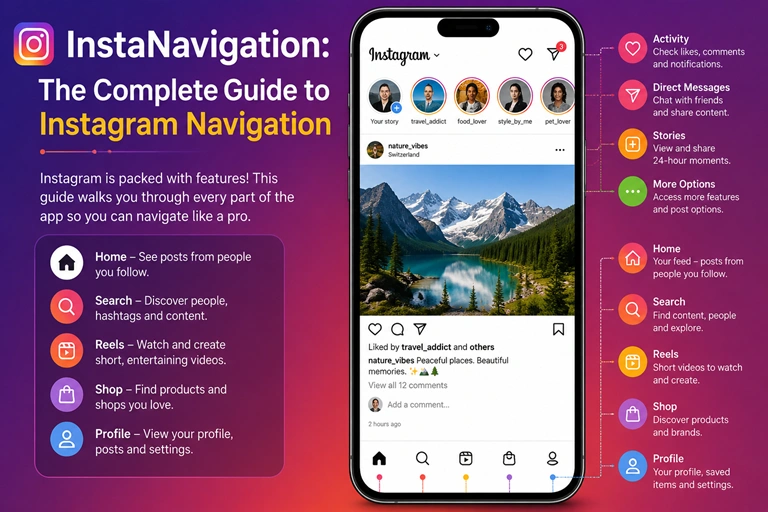
Have you ever opened Instagram to find one post, only to end up jumping between profiles, Reels, hashtags, Stories, and search results? Instagram can feel effortless when you’re casually scrolling, but finding something specific is a different story. That is where the idea of InstaNavigation becomes useful. Understanding how Instagram navigation works can help you move between content types more efficiently, find profiles faster, and spend less time searching for something you saw minutes ago.
Quick Summary
- InstaNavigation refers to the ways users move through Instagram’s different content and profile areas.
- Instagram navigation includes Search, Explore, Reels, Stories, profiles, hashtags, posts, and direct links.
- Good navigation habits can make finding specific Instagram content considerably easier.
- Search terms, usernames, hashtags, profile links, and Instagram’s recommendation surfaces all play different roles.
- Privacy settings and account visibility can affect what users can find or access.
- The best approach is to use the navigation method that matches the type of content you’re trying to locate.
What Is InstaNavigation?
InstaNavigation is a practical way of describing how people navigate through Instagram’s ecosystem. It isn’t necessarily a single standalone Instagram feature. Instead, the term covers the different routes users take to discover, locate, open, and move between Instagram content.
Think about a typical Instagram session. You might start on the home feed, tap a Reel, open the creator’s profile, look through their posts, switch to their tagged content, and then search for another account. Every one of those actions is part of Instagram navigation.
For everyday users, understanding these paths can make Instagram much less frustrating.
For creators, businesses, and publishers, navigation matters for another reason: discoverability. If people can easily move from a post to a profile and from a profile to related content, there are more opportunities for meaningful engagement.
Why Does Instagram Navigation Matter?
Instagram contains an enormous amount of visual content. The challenge isn’t simply finding content; it is finding the right content.
Suppose you remember seeing a cooking Reel from a creator but can’t remember the creator’s username. You might search a phrase related to the recipe, browse relevant results, check profiles, or look through your activity history if you interacted with the post.
That is navigation in practice.
A strong understanding of Instagram’s navigation system can help users:
- Find accounts and creators.
- Locate specific posts or Reels.
- Explore related hashtags and topics.
- Move between profiles and content.
- Discover new accounts.
- Return to content they previously interacted with.
- Understand where Instagram places different types of content.
How Does InstaNavigation Work?
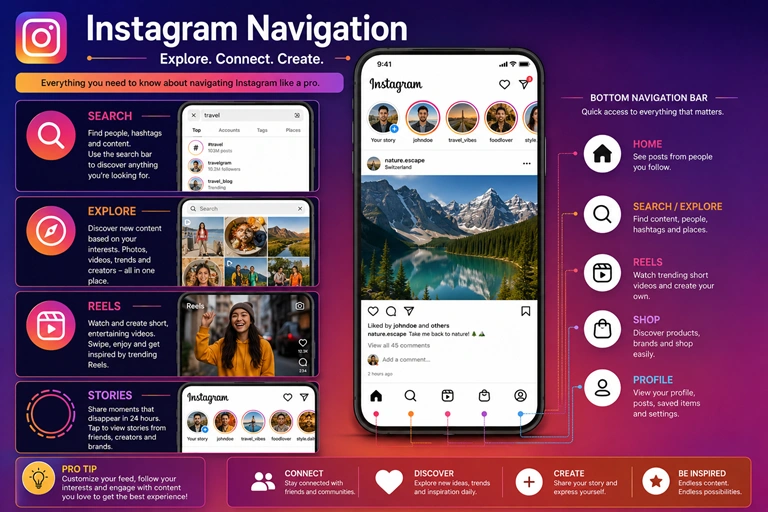
Instagram navigation works through several interconnected areas rather than one central menu. Each area serves a different purpose.
1. Home Feed
The Home feed is usually where a session begins. It presents posts and other content selected according to Instagram’s systems and the accounts or topics a user interacts with.
If you’re looking for content from accounts you already follow, the Home feed is often the most natural starting point.
The limitation is obvious: feeds are dynamic. A post you saw earlier may no longer be immediately visible.
2. Instagram Search and Explore
Search is more useful when you have something specific in mind.
You can search using names, usernames, topics, and other terms. Search can help narrow the enormous amount of content available on the platform.
Explore serves a somewhat different purpose. Rather than simply finding something you already know exists, it can introduce you to content you haven’t encountered before.
This distinction is worth remembering:
Search helps you find something. Explore helps you discover something.
3. Reels Navigation
Reels has become one of Instagram’s major discovery surfaces. Its vertical viewing format encourages users to move rapidly from one piece of content to another.
While watching a Reel, you can generally move toward several destinations:
- The creator’s profile
- Audio or music information
- Comments
- Related content
- Shared content
- Other profile content
If you discover an interesting creator through a Reel, visiting the profile is often the next logical navigation step.
4. Stories
Stories provide another navigation path. Users can move through Stories from accounts they follow and interact with content through available actions.
A Story can also lead to a profile, a product or website where applicable, another account, or additional content.
For businesses and creators, Stories can therefore function as a bridge between temporary content and deeper profile engagement.
5. Instagram Profiles
Profiles are essentially content hubs.
Once you find a profile, you can typically explore its available posts, Reels, bio information, links, and other public-facing content.
This is why profile optimization matters. A person who discovers a creator through one post may immediately visit the profile to answer a simple question: What else does this account publish?
A clear username, recognizable profile image, useful bio, and organized content can make that next navigation step easier.
What Is the Best Way to Navigate Instagram?
There isn’t one universal method. The fastest route depends on what you’re trying to find.
Finding a Specific Person
Start with Instagram Search and enter the most accurate username or name you remember.
If multiple accounts appear, compare profile images, usernames, bios, and other visible information rather than assuming the first result is the correct account.
Finding a Specific Topic
Use descriptive search terms. If you’re looking for photography tutorials, for example, searching a broad term and then refining your query can be more effective than scrolling through the Home feed.
Relevant hashtags can also provide another route to related posts, although hashtag behavior and visibility can change as Instagram updates its platform.
Finding a Reel You Previously Saw
This can be harder if you don’t remember the creator. Try to recall what you interacted with: Did you like it? Comment? Share it? Save it?
Your activity and saved content can be useful starting points when available.
The more specific your memory is—creator name, phrase from the caption, topic, audio, or visual subject—the better your chances of finding the content again.
InstaNavigation Tips for Faster Instagram Browsing
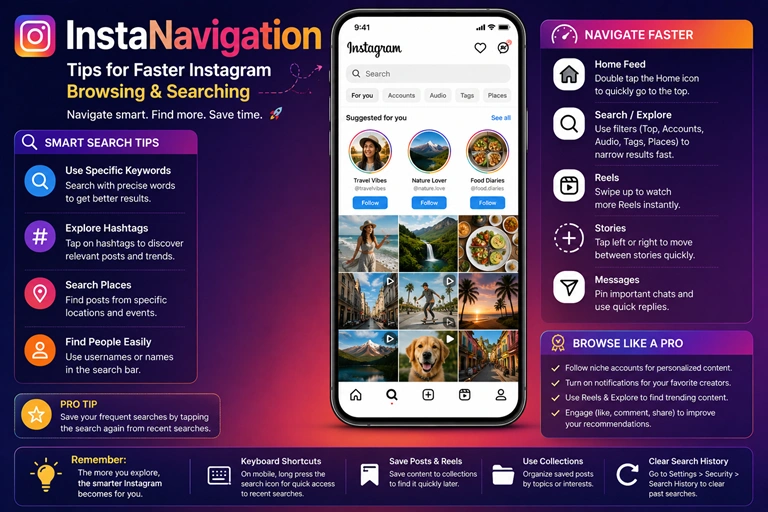
Good Instagram navigation isn’t about knowing obscure tricks. It is mostly about choosing the correct path instead of repeatedly scrolling.
Use Usernames Whenever Possible
A username is generally more precise than a display name. Display names can be shared by many accounts, while usernames are designed to identify individual accounts.
If someone gives you their exact Instagram username, search for that rather than relying on a general name.
Move From Content to Profile
When you find a post you like, don’t keep searching manually for more content from the same creator. Open the profile.
From there, you can explore the account’s other available content.
This simple habit saves time, particularly when you’re researching a creator, business, product, or topic.
Save Useful Content
If you know you’ll need a post later, saving it can be more practical than trying to remember where you found it.
For example, imagine you’re collecting travel ideas for a future trip. Saving useful hotel recommendations, restaurants, attractions, and itinerary ideas creates a much easier return path than relying on your memory.
Use Search With Specific Terms
Searching for “camera photography tips” is generally more useful than entering a vague term such as “camera.”
Specific searches reduce the amount of irrelevant content you need to navigate.
Don’t Confuse Discovery With Verification
Finding an Instagram account does not automatically mean you’ve found the correct person or organization.
This matters especially when researching public figures, brands, businesses, or creators with similar names. Check the profile carefully and look for official links or other reliable identifying information when authenticity matters.
InstaNavigation and Instagram Privacy
Navigation is also influenced by privacy.
A public account can generally be discovered and viewed more easily than a private account. Private profiles restrict access to certain content, meaning that navigation can lead you to a profile without necessarily giving you access to everything published there.
Users should also remember that visibility isn’t the same as ownership or permission. Just because content can be found doesn’t mean it should be copied, republished, or used commercially without appropriate rights.
For creators, privacy and account settings are worth reviewing regularly, particularly if the account contains personal information.
For users searching for other people, respect the boundaries established by private accounts. A navigation method should help you find legitimate public information—not bypass someone’s privacy controls.
Why InstaNavigation Matters for Creators and Businesses
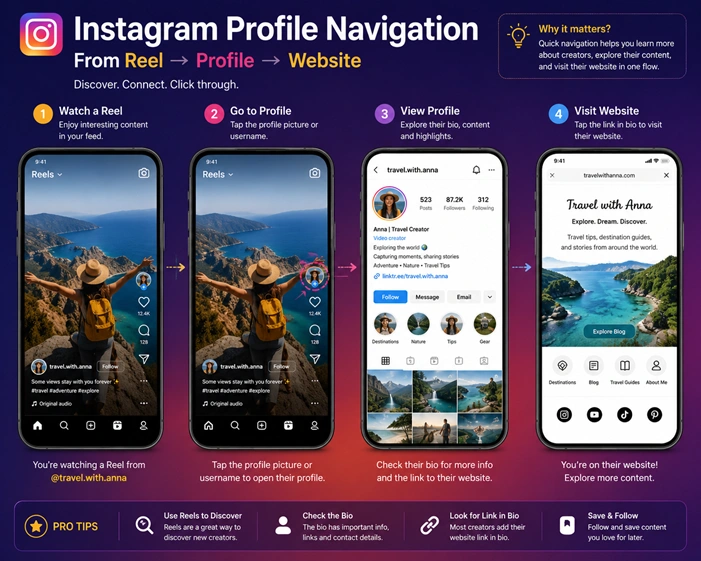
Creators often focus heavily on reach, likes, and views. Those numbers matter, but what happens after someone discovers a post?
That’s where navigation becomes interesting.
A person might:
Reel → Profile → Bio → Website → Product
or:
Post → Profile → Reels → Follow
or:
Story → Profile → Other Content → Direct Message
These paths show why individual pieces of content shouldn’t exist in isolation.
A creator’s profile should make sense after someone arrives from a Reel. A business account should make it easy to understand what the company offers. Important links should be accessible without making visitors hunt for them.
In other words, successful Instagram navigation is partly about reducing friction.
Build Content That Gives People a Reason to Continue
If someone discovers one useful post, related content should be easy to find.
For example, a fitness creator could organize content around beginner workouts, equipment guides, nutrition information, and advanced routines. A visitor arriving through one post can then naturally explore related topics.
That creates a better user experience and can encourage deeper engagement.
Common InstaNavigation Mistakes to Avoid
Even experienced Instagram users can make navigation harder than necessary.
Using overly broad searches: Generic terms produce more results and make finding the right account harder.
Ignoring profile information: A profile’s bio and links can often provide useful context about who operates the account.
Relying entirely on the Home feed: Feeds are designed for ongoing discovery, not necessarily for locating one specific post.
Failing to save important content: If something matters, save it when possible rather than assuming you’ll find it again.
Treating search results as proof of authenticity: Search helps with discovery, but important claims should be verified through trustworthy sources.
FAQ About InstaNavigation
What does InstaNavigation mean?
InstaNavigation refers to the different ways users navigate Instagram, including Search, Explore, Reels, Stories, profiles, posts, hashtags, and links. It describes the overall process of finding and moving between Instagram content.
How can I navigate Instagram more efficiently?
Use specific search terms, exact usernames when available, saved posts, profile pages, and relevant content sections instead of relying entirely on endless feed scrolling. The best method depends on what you’re trying to find.
Can I find an Instagram post I previously viewed?
It may be possible depending on your interaction with the content and the account. If you liked, saved, commented on, or otherwise interacted with a post, relevant account or activity areas may provide a path back to it.
Does Instagram navigation work differently for private accounts?
Yes. Private accounts restrict access to certain content. You may be able to find the profile, but posts and other information may remain unavailable unless the account grants you access.
Conclusion
InstaNavigation is best understood as the collection of routes that help people find and explore Instagram content. Once you understand the purpose of Search, Explore, Reels, Stories, profiles, and saved or previously interacted-with content, Instagram becomes much easier to navigate.
For users, the biggest practical lesson is simple: start with the navigation path that matches your goal. Search for something specific, use Explore for discovery, open profiles when you want more from a creator, and save useful content when you know you’ll need it later.
For creators and businesses, think about what happens after someone discovers you. Making that next step obvious can turn a single view into a profile visit, follow, conversation, or long-term audience relationship.