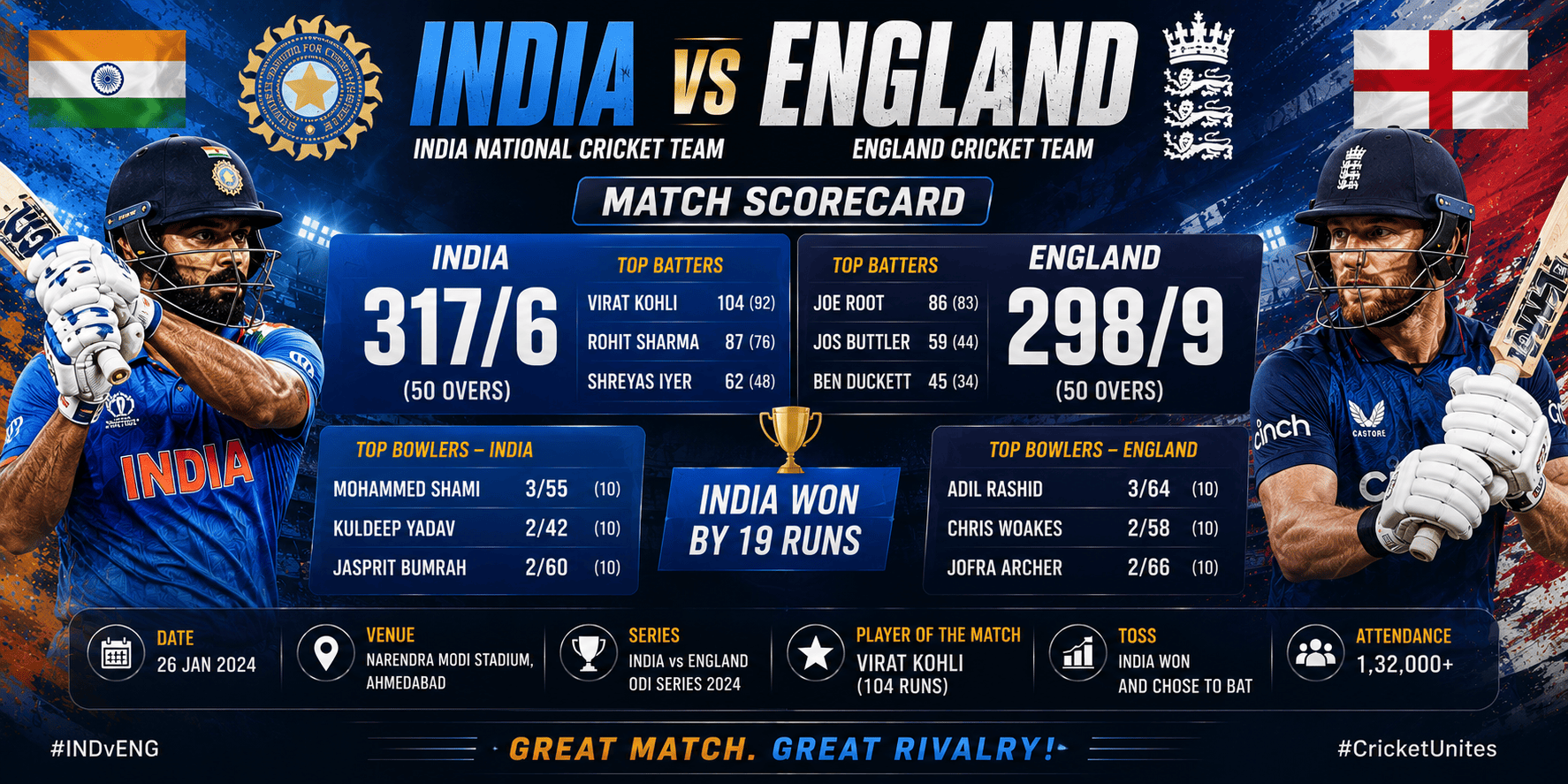
Cricket fans across India witnessed one of the most electrifying nights in Mumbai’s cricketing history when the India national cricket team vs England cricket team match scorecard from the ICC Men’s T20 World Cup 2026 Second Semifinal at Wankhede Stadium on March 5, 2026 delivered every superlative the occasion demanded. Sanju Samson’s magnificent 89 off 42 balls powered India to their highest-ever total in T20 World Cup knockouts — 253/7 — before Jacob Bethell’s astonishing 105 off 48 balls brought England to the very brink of an historic upset. Then Jasprit Bumrah delivered what his captain Suryakumar Yadav called a “superpower” — a six-ball, six-run 18th over of clinical yorker mastery that swung the match irreversibly India’s way before Hardik Pandya’s precision 19th over sealed England’s fate. India advanced to the T20 World Cup 2026 final by 7 runs in a match that produced the highest-ever match aggregate — 499 runs — the highest match aggregate involving England and India in T20Is and the highest involving both teams in Men’s T20 World Cup history. Indian cricket fans watching every ball live on JioHotstar and Star Sports will not forget this Wankhede night for years to come. This comprehensive India national cricket team vs England cricket team match scorecard covers every detail — complete batting and bowling figures, partnerships, fall of wickets, turning points, and individual performance analysis.
Match Overview
Suryakumar Yadav, India captain: Unbelievable feeling. Playing in India, leading an unbelievable side. Samson knew what he knew right when he went in. Team required it from him, it was due. I told Harry how much more do we need to score against them. They were always in the chase, but the way the bowlers pulled the game away was unbelievable. You know how capable Bumrah is.
The match was always going to be a spectacle. India, defending champions of the T20 World Cup, hosted England — their most contested ICC tournament opponent — at Wankhede Stadium in front of a near-capacity crowd whose noise levels produced an atmosphere that players from both teams described as unlike any they had experienced in T20 cricket. England won the toss and chose to field — a decision that reflected confidence in their pace attack to restrict India on a Wankhede surface that had offered inconsistent bounce throughout the tournament.
Of all the IND vs ENG encounters in the T20 World Cups, it’s the Men In Blue who hold the edge over England, 3-2 in T20 World Cups. That historical record, combined with India’s home advantage in front of a Mumbai crowd that generates one of sport’s most extraordinary atmospheres, made England’s decision to field first feel brave rather than strategically certain.
Read More: Pakistan National Cricket Team and the England Cricket Team
Match Details Table
| Match Information | Details |
|---|---|
| Match | ICC Men’s T20 World Cup 2026, 2nd Semifinal |
| Format | T20 International |
| Venue | Wankhede Stadium, Mumbai |
| Date | March 5, 2026 (Night Match) |
| Toss | England won, elected to field first |
| Result | India won by 7 runs |
| Player of the Match | Sanju Samson (89 off 42 balls) |
| Series Context | India advanced to T20 World Cup 2026 Final vs New Zealand |
| Match Aggregate | 499 runs — highest ever between IND & ENG in T20Is |
| Broadcast (India) | JioHotstar / Star Sports |
| T20I No. | 3752 |
Harry Brook, England captain: We thought there might’ve been hold, spin in the first innings, slid onto the bat nicely and India batted well.
Full Scorecard & Statistical Analysis
Match Summary Table
| Team | Innings | Total | Wickets | Overs | Run Rate |
|---|---|---|---|---|---|
| India | 1st Innings | 253 | 7 | 20.0 | 12.65 |
| England | 1st Innings | 246 | 7 | 20.0 | 12.30 |
Result: India won by 7 runs
This is the highest match aggregate (499) involving England and India in T20Is and the highest match aggregate involving England and India in Men’s T20 World Cup. The seven-run margin — with both teams scoring above 12 runs per over across the full 40 overs — encapsulates a match where batting dominated comprehensively until Bumrah’s single over of disciplined genius changed cricket’s arithmetic in the most dramatic fashion possible.
India Batting Innings Breakdown
India Batting Scorecard
| Batsman | Dismissal | Runs | Balls | 4s | 6s | Strike Rate |
|---|---|---|---|---|---|---|
| Abhishek Sharma | c (deep mid-wicket) b Jacks | 20 | — | — | — | — |
| Sanju Samson (wk) | c Salt b Jacks (sweeper cover) | 89 | 42 | 7 | — | 211.90 |
| Ishan Kishan | c Jacks (long-off) b Rashid | — | — | — | — | — |
| Suryakumar Yadav (c) | — | — | — | — | — | — |
| Tilak Varma | — | — | — | — | — | — |
| Hardik Pandya | — | — | — | — | — | — |
| Shivam Dube | — | 43 | 25 | — | — | 172.00 |
| Axar Patel | not out | 2 | — | — | — | — |
| Varun Chakravarthy | not out | 0 | — | — | — | — |
Extras: 10 | Total: 253/7 (20 overs)
Sanju Samson, Player of the Match: Feels great, I knew I got some form going from the last game. I thought I need to make the most out of my form, gave myself extra time. We know no score is stoppable, wanted as much as possible. England came close, played really well. Good semi-final. You need to assess conditions, we’ve played a lot of cricket here, know chasing is easier. But the way myself and Ishan batted, we knew 250 should be possible. Very happy. All credit goes to Bumrah, once in a generation. Think this award should go to him.
Abhishek holes out in the first over — offspin his kryptonite again. There’s only one man out there but Jacks sends it straight down his throat. The stadium goes quiet as Abhishek walks off forlornly. Match-up gold from England, although on another day that ball disappears over deep midwicket for six — 20/1.
Abhishek Sharma’s early dismissal — falling to the specific off-spin match-up that England had clearly pre-planned — placed India’s innings under immediate early pressure that Samson answered with controlled authority. His entry at No. 2 gave India a batsman already in his best form of the tournament, and from the moment he middled his first ball, the innings took a different direction entirely.
Samson’s 89 off 42 balls was a masterclass of progressive acceleration — reaching 52 in 26 balls before shifting into a higher gear that made England’s fielders appear to be standing in the wrong positions regardless of how often Harry Brook adjusted them. Samson reached 52 runs in 26 balls — 4 fours and 3 sixes. India reached 100 runs in 8.3 overs. His partnership with Ishan Kishan — the second wicket stand that added 97 runs and took India from 20/1 to 117/2 — represented the match’s most significant batting construction, both batsmen understanding precisely how much Mumbai’s placid Wankhede surface was going to assist batting and calibrating their aggression accordingly.
Kishan holes out — Rashid does the job for England. Front of the hand, sliding on as Kishan looks to launch downtown. Big miscue into the Mumbai sky and Jacks makes no mistake trotting in from long-off. England finally break the second-wicket stand — 117/2.
Shivam Dube’s 43 off 25 balls in the death overs — capitalising on the platform Samson and Kishan had built — gave India the late acceleration that transformed a par total of around 220 into the tournament record of 253. India records highest-ever total in T20 World Cup knockouts.
England Cricket Team Bowling — India Innings
England Bowling Figures
| Bowler | Overs | Maidens | Runs | Wickets | Economy | Bowling Figures |
|---|---|---|---|---|---|---|
| Will Jacks | 4 | 0 | 40 | 2 | 10.00 | 4-0-40-2 |
| Adil Rashid | 4 | 0 | 41 | 2 | 10.25 | 4-0-41-2 |
| Jofra Archer | 4 | 0 | 61 | 0 | 15.25 | 4-0-61-0 |
| Sam Curran | 4 | 0 | — | — | — | — |
| Liam Dawson | 4 | 0 | — | — | 10.00+ | — |
| Shivam Dube (IMP) | 1 | 0 | 22 | 0 | 22.00 | 1-0-22-0 |
Jofra Archer has conceded the most runs in an innings (61) in Men’s T20 World Cup for England, going past Stuart Broad’s record of 60. Archer’s expensive figures — costly as they were — reflected the specific challenge of bowling pace at Wankhede’s pace-friendly surface when batsmen of Samson and Dube’s quality are fully settled and attacking. His length deliveries were targeted over midwicket; his full balls driven straight or through cover; his short balls pulled with conviction by batsmen whose eyes were in.
Will Jacks’ 2/40 — his off-spin extracting two important wickets through match-up exploitation of Abhishek Sharma’s specific weakness against off-spin, and then dismissing Samson on 89 through a sweeper-cover catch — represented England’s most clinically planned bowling contribution. It was a wide 89km/h length ball from Jacks, slanting away due to the around-the-wicket angle. Samson reached out and looked to slap it, gets it off the bottom of the bat. Salt, at sweeper cover, takes it — 160/3.
Adil Rashid’s 2/41 — claiming the key wicket of Ishan Kishan with a sliding wrong’un — confirmed England’s spin bowling quality even as their pace attack struggled to contain India’s batting depth.
Fall of Wickets — India Innings
| Wicket | Score | Batsman Dismissed | Over |
|---|---|---|---|
| 1st | 20/1 | Abhishek Sharma | 1.6 |
| 2nd | 117/2 | Ishan Kishan | 9.3 |
| 3rd | 160/3 | Sanju Samson | 13.1 |
| 4th | 190/4 | Suryakumar Yadav | 15.4 |
| 5th | 212/5 | Shivam Dube | 17.3 |
| 6th | 236/6 | Tilak Varma | 18.5 |
| 7th | 251/7 | Hardik Pandya | 19.5 |
The fall of wickets chart reveals India’s innings in three distinct phases. Phase one — the early Abhishek dismissal followed by Samson-Kishan’s 97-run platform — laid the tournament-record foundation. Phase two — the cluster of wickets between overs 13 and 19 — reflected the risk-taking required to score above 12 runs per over in the death, with each batsman accepting dismissal as the price of the boundary-count that pushed India toward 250. Phase three — the final over’s two wickets while conceding 22 runs — confirmed that India’s lower order understood their role as accelerators rather than savers of wickets.
Read More: Ishan Kishan Biography — Height in Feet, Age, Stats, IPL 2026 Team
England Cricket Team Batting Innings Breakdown — The Chase
England Batting Scorecard
| Batsman | Dismissal | Runs | Balls | 4s | 6s | Strike Rate |
|---|---|---|---|---|---|---|
| Phil Salt | c (covers) b Pandya | 13 | — | — | — | — |
| Jos Buttler (wk) | b Varun Chakravarthy (wrong’un) | — | — | — | — | — |
| Harry Brook (c) | c Axar b Bumrah (slower ball) | — | — | — | — | — |
| Jacob Bethell | run out (Pandya / †Samson) | 105 | 48 | 8 | 7 | 218.75 |
| Tom Banton | b Axar Patel | — | — | — | — | — |
| Will Jacks | c (relay — Axar/Dube) b Arshdeep | 35 | 20 | — | — | 175.00 |
| Sam Curran | b Pandya | — | — | — | — | — |
| Jamie Overton | not out | 2 | 3 | — | — | 66.67 |
| Jofra Archer | not out | 19 | 4 | — | 3 | 475.00 |
Total: 246/7 (20 overs) | Target: 254 | Lost by 7 runs
Bethell’s astonishing 105 from 48 balls almost got England home chasing 254.
England’s chase produced one of the most extraordinary individual batting performances in T20 World Cup semifinal history — and one of the most extraordinary bowling performances in the same match. The two exist in direct counterpoint: Bethell’s genius almost overcoming Bumrah’s mastery in a contest between individual brilliance and collective Indian bowling discipline that produced the most compelling cricket India has hosted since the 2011 ODI World Cup final.
Phil Salt holes out first ball — full outside off and there’s some swing. Salt aims a wallop down the ground and skies it into the covers — 13/1. Buttler’s mojo isn’t coming back — flighted googly, 95kph, hits the top of middle stump as Buttler heaves blindly. Varun smiles, maybe breathes a sigh of relief — 64/3.
Jasprit Bumrah provides India with a crucial breakthrough as Harry Brook departs after a clever slower ball. Brook backs away looking to force the shot but mistimes it, sending the ball looping over the cover region. Axar Patel shows great awareness in the field, running back and completing a sharp diving catch.
With England at 95/4 after 7.3 overs — requiring 159 from 75 balls — the match appeared over. Then Bethell began.
Jacob Bethell has played a dream innings here to give England a chance at dreaming. It started with three straight sixes off Varun Chakravarthy. Then two fours off the back foot off the same bowler. He got to fifty in just 19 balls — the fastest World Cup half-century for England, going past his partner Will Jacks’ 21 against Italy earlier this World Cup. Then celebrated it with a pulled four off Bumrah.
He finished with figures of 1/64 with an economy rate of 16. Bethell was the most effective against the spinner, scoring 43 runs off just 13 balls. Bethell’s assault on Varun Chakravarthy — three consecutive sixes in the spinner’s first over — exposed the mystery spinner’s vulnerability on a surface offering minimal assistance to wrist-spin, and confirmed that England had specifically prepared to target Chakravarthy as India’s most exploitable bowling option.
Jacob Bethell reached 102 runs in 45 balls — 4 x 8, 6 x 7. A 50-run partnership of 26 balls with Sam Curran — Bethell 29 from 13, Curran 18 from 13.
India Bowling — England Chase
India Bowling Figures
| Bowler | Overs | Maidens | Runs | Wickets | Economy | Bowling Figures |
|---|---|---|---|---|---|---|
| Hardik Pandya | 4 | 0 | 38 | 2 | 9.50 | 4-0-38-2 |
| Jasprit Bumrah | 4 | 0 | 33 | 1 | 8.25 | 4-0-33-1 |
| Arshdeep Singh | 4 | 0 | — | 1 | — | — |
| Axar Patel | 4 | 0 | — | 1 | — | — |
| Varun Chakravarthy | 4 | 0 | 64 | 1 | 16.00 | 4-0-64-1 |
| Shivam Dube | 1 | 0 | 22 | 0 | 22.00 | 1-0-22-0 |
Varun has conceded the most runs in an innings (64) in Men’s T20 World Cup for India, going past Joginder Sharma’s record of 57.
Prior to the T20 World Cup 2026 semi-final against England, Varun had 12 wickets to his name at an economy rate of 7.66. He has figures of 1/24, 3/7, 2/17, 3/14, 1/47, 1/35 and 1/40 before this contest but has been expensive particularly since the Super 8 stage. Chakravarthy now has the joint second-most expensive returns for India in all T20Is.
Bumrah’s 1/33 across four overs — conceding just 33 runs in a match where both teams scored above 12 per over — represents his most significant contribution of this World Cup in context terms. You knew, therefore, almost exactly what you were going to get from the 18th over. Bumrah would spear ball after ball into the base of the stumps from around the wicket. Six balls, six yorkers or near-yorkers, six runs, no wickets, and a stadium on its feet, feeling blessed to have witnessed this spectacle.
“All credit goes to Jasprit Bumrah. World-class bowler, once-in-a-generation bowler — that’s what he delivered today. I think this should go to him, actually. If he didn’t bowl that way in the death overs, I would not be standing here” — Sanju Samson.
Hardik Pandya’s 2/38 — including the critical dismissal of Sam Curran in the 19th over that reduced England’s equation to 30 from the final over — was equally decisive. Hardik Pandya bowled a remarkable 19th over, giving just 9 runs and took the prized wicket of Sam Curran, leaving 30 runs for Shivam Dube in the last over.
Fall of Wickets — England Innings
| Wicket | Score | Batsman Dismissed | Over |
|---|---|---|---|
| 1st | 13/1 | Phil Salt | 1.1 |
| 2nd | 38/2 | Harry Brook | 4.1 |
| 3rd | 64/3 | Jos Buttler | 5.5 |
| 4th | 95/4 | Tom Banton | 7.3 |
| 5th | 172/5 | Will Jacks | 13.6 |
| 6th | 222/6 | Sam Curran | 18.3 |
| 7th | 225/7 | Jacob Bethell (run out) | 19.1 |
The fall of wickets tells the match’s decisive story. England’s powerplay collapse — four wickets for 95 runs in 7.3 overs — should have ended any realistic hope of chasing 254. Bethell’s extraordinary partnership with Will Jacks (77 runs from overs 8–14) and then Sam Curran (50 runs from overs 14–18) suggested otherwise. England need 69 off the last five. Jasprit Bumrah has two left. Crucial overs.
Bethell’s run-out on the first ball of the 20th over — by Hardik Pandya’s direct throw to Samson behind the stumps — ended England’s last realistic hope at 225/7. Bethell faces the first ball and he gets run out while trying to sneak a double. That’s a big big blow for England and India have their one foot in the final now.
Key Partnerships
India Innings Partnerships
| Wicket | Partners | Runs | Balls | Note |
|---|---|---|---|---|
| 2nd wicket | Samson & Kishan | 97 | — | Match-defining partnership — 20/1 to 117/2 |
| 4th wicket | Suryakumar & Dube | 30 | — | Middle-order momentum |
| Late partnerships | Dube, Varma, Pandya | 136 | — | Death overs acceleration — 117 to 253 |
England Innings Partnerships
| Wicket | Partners | Runs | Balls | Note |
|---|---|---|---|---|
| 3rd wicket | Bethell & Jacks | 77 | 44 | England’s revival from 95/4 |
| 6th wicket | Bethell & Curran | 50 | 26 | Genuine title threat — 172 to 222 |
Match Highlights & Turning Points
Turning Point 1 — Abhishek’s First-Over Dismissal (Over 1.6): Abhishek holes out — offspin his kryptonite again. Match-up gold from England, although on another day that ball disappears over deep midwicket for six. England’s pre-planned off-spin match-up against Abhishek Sharma — exploiting his specific technical vulnerability against the turning ball — produced India’s first wicket before they had settled, momentarily handing England the psychological momentum they had won by winning the toss.
Turning Point 2 — Samson-Kishan’s 97-Run Second Wicket Stand: India’s batting platform was rebuilt through Samson’s controlled aggression and Kishan’s complementary left-handed approach that gave England’s bowlers a constantly changing angle problem. The way myself and Ishan batted, we knew 250 should be possible — Sanju Samson. Their partnership took India from a precarious 20/1 to 117/2 with ten overs to bat — turning England’s early advantage into a total that 253 ultimately represented.
Turning Point 3 — Bethell’s Three Consecutive Sixes Off Chakravarthy (Over 6): Jacob Bethell sits back first ball to pull a shortish ball over mid-on. Then three straight sixes off Varun Chakravarthy. In three balls, Bethell changed England’s chase from mathematically improbable to statistically competitive, simultaneously exposing Chakravarthy’s limitations on the Wankhede surface and establishing a batting framework that made the remainder of his extraordinary innings possible.
Turning Point 4 — Bumrah’s 18th Over: Six Yorkers, Six Runs: Six balls, six yorkers or near-yorkers, six runs, no wickets, and a stadium on its feet, feeling blessed to have witnessed this spectacle. You knew Bumrah would go fast, full, straight, at the stumps, and do it six times in six balls. England required 61 from four overs before Bumrah’s 18th over; they required 39 from two after it. Those six yorkers — bowled against Sam Curran and Bethell, two of England’s most dangerous hitters, at a point where both were fully set — represented a single over of sustained physical and technical excellence that decided a T20 World Cup semifinal.
Turning Point 5 — Bethell’s Run-Out (Over 19.1): Bethell faces the first ball and he gets run out while trying to sneak a double. That’s a big big blow for England and India have their one foot in the final now. Hardik Pandya’s direct throw — precise, rapid, and executed under the pressure of a World Cup semifinal’s final over — removed England’s last match-winner with 29 balls remaining and the target 29 runs away. The dismissal’s symmetry — the exact run required equalling the balls available — made it one of cricket’s most precisely dramatic single moments.
Player of the Match Performance
Sanju Samson won the Player of the Match award for his 89 off 42 balls.
Sanju Samson: It isn’t easy to find your form in crucial games for your country, but I knew this was a big game and I needed to make use of how well I’m batting. I gave myself a bit of extra time, I calculated my innings and I prepared well so that’s why things came off really nicely. Hundred doesn’t matter, it’s not a Test or an ODI game where you can go up and down. Happy to get whatever I’m getting and in a winning effort.
Samson’s 89 — stopped just short of what would have been a second successive World Cup knockout century — was the innings that gave India their tournament record total and the platform from which Bumrah’s genius could operate. His ability to calculate innings construction so precisely — understanding when to take singles to maintain strike, when to attack specific bowlers, and when to accept dismissal as the cost of risk — reflects a cricket intelligence that makes him the most complete expression of India’s modern T20I batting philosophy.
Faf du Plessis: Jasprit Bumrah is like a genie — a superpower that any captain will dream of. Bumrah’s 1/33 — in a match where both teams scored at 12-plus runs per over — was statistically extraordinary. His 18th over’s six consecutive yorkers against set batsmen in a T20 World Cup semifinal represent one of the finest individual bowling achievements in the tournament’s history.
Squad Information
India Playing XI
| Player | Role | Batting Style | Bowling Style |
|---|---|---|---|
| Abhishek Sharma | Batsman | Left-hand bat | Slow left-arm orthodox |
| Sanju Samson (wk) | Batsman | Right-hand bat | — |
| Ishan Kishan | Batsman | Left-hand bat | — |
| Suryakumar Yadav (c) | Batsman | Right-hand bat | Right-arm off-break |
| Tilak Varma | Batsman | Left-hand bat | — |
| Hardik Pandya | All-rounder | Right-hand bat | Right-arm fast-medium |
| Shivam Dube | All-rounder | Left-hand bat | Right-arm medium |
| Axar Patel | All-rounder | Left-hand bat | Slow left-arm orthodox |
| Arshdeep Singh | Bowler | Left-hand bat | Left-arm fast-medium |
| Varun Chakravarthy | Bowler | Right-hand bat | Right-arm wrist-spin |
| Jasprit Bumrah | Bowler | Right-hand bat | Right-arm fast |
England Playing XI
| Player | Role | Batting Style | Bowling Style |
|---|---|---|---|
| Phil Salt | Batsman | Right-hand bat | — |
| Jos Buttler (wk) | Batsman | Right-hand bat | — |
| Harry Brook (c) | Batsman | Right-hand bat | Right-arm off-break |
| Jacob Bethell | All-rounder | Left-hand bat | Slow left-arm orthodox |
| Tom Banton | Batsman | Right-hand bat | — |
| Sam Curran | All-rounder | Left-hand bat | Left-arm fast-medium |
| Will Jacks | All-rounder | Right-hand bat | Right-arm off-break |
| Jamie Overton | All-rounder | Right-hand bat | Right-arm fast-medium |
| Liam Dawson | All-rounder | Left-hand bat | Slow left-arm orthodox |
| Jofra Archer | Bowler | Right-hand bat | Right-arm fast |
| Adil Rashid | Bowler | Right-hand bat | Leg-break googly |
Star Players to Watch
Jasprit Bumrah (India): This is a man who has mastered pretty much every delivery that has existed in the history of fast bowling. But late in a T20 game, when India are defending a total, when he’s operating on one of the flattest and least forgiving pitches the Wankhede Stadium has ever produced, you know he’s going to pare his art down to its fundamentals, to the thing that first made his name. Bumrah’s 18th over confirmed what the T20 World Cup 2026 has repeatedly demonstrated — he is the single most valuable bowling asset in world cricket at this moment.
Jacob Bethell (England): Jacob Bethell run out — 105 off 48 balls, 8 fours, 7 sixes, strike rate 218.75. Bethell’s innings — Bethell goes into a bubble to almost burst India’s dreams at Wankhede — confirmed the 22-year-old’s emergence as England’s most dangerous T20 batsman, capable of dismantling any bowling attack in any condition when his eye is in.
Sanju Samson (India): Two consecutive high-quality innings in T20 World Cup knockout stages confirm Samson’s arrival as India’s most reliable batting match-winner in high-stakes knockout situations — the pressure player his critics suggested he could never be.
Hardik Pandya (India): His 19th over — nine runs conceded, Sam Curran dismissed, England’s chase effectively ended — was the tactical execution of a death bowler operating at peak craft under maximum pressure.
Match Summary & Conclusion
The India national cricket team vs England cricket team match scorecard from the ICC Men’s T20 World Cup 2026 Semifinal at Wankhede Stadium will be remembered through three individual performances that collectively define what elite T20 cricket can produce. Samson’s 89 built the platform. Bethell’s 105 almost made it irrelevant. Bumrah’s 18th over made it permanent. This is the highest match aggregate (499) involving England and India in T20Is — a statistical landmark that perfectly captures a match where attacking cricket dominated across all 40 overs, yet where seven runs ultimately separated two of the sport’s great T20 nations.
India advanced to face New Zealand in the T20 World Cup 2026 final at Ahmedabad — chasing their third T20 World Cup title and their second in consecutive editions. England’s elimination, despite Bethell’s stunning individual contribution, confirmed that no individual innings — however extraordinary — can substitute for the collective bowling discipline that Bumrah provides to India in tournament cricket’s most pressurised moments.
So, it’s set. A Sunday final between India and New Zealand at Ahmedabad. We’ll have a three-time champion or a new one.
Frequently Asked Questions
Who won the India vs England T20 World Cup 2026 Semifinal?
India won by 7 runs at Wankhede Stadium, Mumbai on March 5, 2026. India 253/7 in 20 overs beat England 246/7 in 20 overs. This is the highest match aggregate (499) involving England and India in T20Is.
Who was the Player of the Match in India vs England T20 World Cup 2026?
Sanju Samson won the Player of the Match award for his 89 off 42 balls. His second-wicket partnership with Ishan Kishan — adding 97 runs — and his calculated innings construction gave India their tournament-record total.
What was Jacob Bethell’s score in the India vs England T20 World Cup 2026 Semifinal?
Jacob Bethell scored 105 off 48 balls — 8 fours and 7 sixes — at a strike rate of 218.75 before being run out on the first ball of the final over. Bethell’s astonishing 105 from 48 balls almost got England home chasing 254.
What happened in Bumrah’s 18th over against England?
You knew Bumrah would go fast, full, straight, at the stumps, and do it six times in six balls. Six balls, six yorkers or near-yorkers, six runs, no wickets, and a stadium on its feet, feeling blessed to have witnessed this spectacle. The over reduced England’s requirement from 61 from 4 overs to 39 from 2, effectively deciding the match.
What was Varun Chakravarthy’s performance in the T20 World Cup 2026 Semifinal?
Varun has conceded the most runs in an innings (64) in Men’s T20 World Cup for India, going past Joginder Sharma’s record of 57. Bethell was the most effective against the spinner, scoring 43 runs off just 13 balls.
Did India qualify for the T20 World Cup 2026 Final?
Yes. India advanced to the T20 World Cup 2026 final to face New Zealand at Ahmedabad, with the winner becoming either a three-time T20 World Cup champion or a new champion.
Where can Indian fans watch India vs England cricket matches?
All ICC tournament matches and bilateral series between India and England are broadcast on the Star Sports network in India and streamed live on JioHotstar, with free mobile streaming and multiple regional language commentary options available on both platforms.