The England-Australia cricket rivalry has produced everything Test cricket can offer: extraordinary batting, hostile bowling, controversial tactics, dramatic collapses and matches that have become part of sporting folklore.
Read Also: Royal Challengers Bengaluru vs Gujarat Titans Timeline: Complete IPL 2026 Story
The latest Ashes chapter added another strange twist.
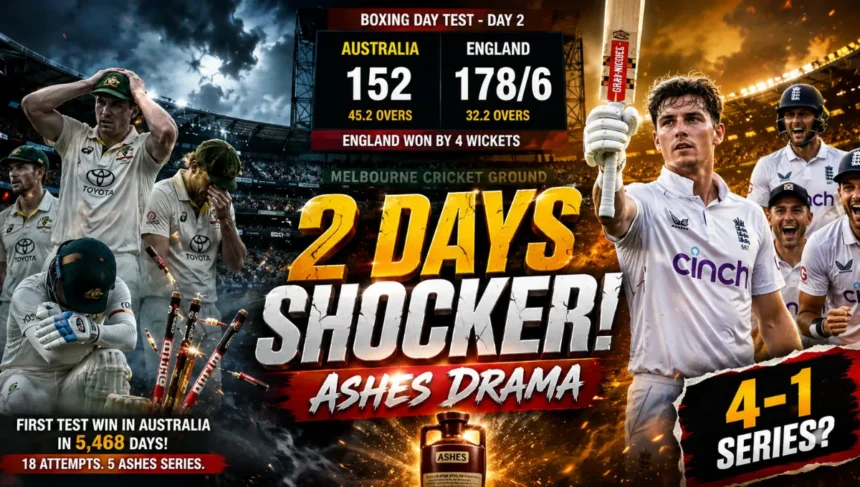
On December 26, 2025, at the Melbourne Cricket Ground, Australia were dismissed for 152 in 45.2 overs during the Boxing Day Test. England replied with 178/6 in only 32.2 overs and won by four wickets inside two days.
For England, it was a historic result. It ended a long wait for an Ashes Test victory on Australian soil.
Yet the wider series told a very different story.
Australia won the fifth Test in Sydney by five wickets and finished the 2025-26 Ashes with a 4-1 series victory. England had finally ended its drought in Australia, only for Australia to retain the Ashes comfortably.
That contradiction sums up this rivalry better than almost anything else: even a historically significant England victory can become a footnote when Australia are dominant across the series.
England vs Australia Head-to-Head Snapshot
| Format | Matches | England Wins | Australia Wins | Draws/Tied/NR |
|---|---|---|---|---|
| Tests | 370+ [VERIFY] | 110 [VERIFY] | 147 [VERIFY] | 90+ [VERIFY] |
| ODIs | 140+ [VERIFY] | 55 [VERIFY] | 85 [VERIFY] | — |
| T20Is | 30+ [VERIFY] | 14 [VERIFY] | 16 [VERIFY] | — |
| Ashes series | 73 [VERIFY] | — | Australia since 2017 | 1 drawn in 2023 |
Australia have the overall advantage in every major international format. They have also retained the Ashes since the 2017-18 series.
England’s long-term record against Australia is still substantial. The 110 Test victories listed above would make Australia their most frequently defeated major Test opponent, although the exact totals should be checked against the latest official records. [VERIFY]
The modern Australian home record, however, is where the gap becomes particularly noticeable.
How the Ashes Started: The Famous 1882 Obituary
The Ashes story began at The Oval in London in August 1882, when Australia defeated England on English soil for the first time.
The defeat inspired one of cricket’s most famous pieces of sporting satire.
The Sporting Times published a mock obituary for English cricket, declaring that it had died at The Oval and that its ashes would be taken to Australia.
That joke eventually became the name of the greatest rivalry in Test cricket.
England captain Ivo Bligh subsequently travelled to Australia and spoke about recovering the Ashes. Following England’s success, a small terracotta urn was presented to Bligh. The object was reportedly associated with the ashes of a cricket bail.
The urn itself has an unusual status.
It is not a conventional sporting trophy that changes physical possession after every series. The original urn has remained at the MCC Museum at Lord’s. When Australia or England “holds the Ashes,” the phrase refers to the symbolic possession of the urn rather than the physical object itself.
That distinction is part of what makes the Ashes different from almost every other international sporting contest.
The Defining Ashes Eras
1932-33 Bodyline Series: Cricket’s Most Controversial Ashes
The 1932-33 Ashes tour of Australia remains one of the most controversial episodes in cricket history.
England arrived with a strategy designed largely around stopping Australia’s greatest batsman, Don Bradman. Captain Douglas Jardine instructed his bowlers to use short-pitched deliveries directed towards the body, while Harold Larwood supplied the extreme pace.
The tactic became known as Bodyline, or fast-leg theory.
England won the five-Test series 4-1. Bradman still averaged 56.57, but the methods used to contain him created enormous controversy.
The dispute went beyond cricket.
Relations between the two cricketing nations deteriorated badly, and the controversy contributed to subsequent changes in cricket’s playing regulations concerning field placements and short-pitched bowling.
Bodyline is therefore remembered not simply as an unusual tactical plan. It was an episode that forced cricket administrators to consider where the boundary should sit between aggressive strategy and physical danger.
England won the series, but the controversy became its lasting legacy.
1948: Bradman’s Invincibles
The 1948 Australian touring team remains one of the most celebrated sides in cricket history.
Led by Don Bradman, Australia went through the English tour unbeaten in first-class cricket. They won four of the five Tests, with the other ending in a draw.
The side became known as The Invincibles.
Bradman’s own career numbers are legendary. His Test batting average of 99.94 remains one of the most famous statistics in sport.
His final Test innings created an equally famous piece of cricketing drama.
At The Oval in 1948, Bradman needed only four runs to finish his Test career with an average of exactly 100. Instead, England’s Eric Hollies dismissed him for a duck.
Bradman therefore retired with 99.94.
The difference between 99.94 and the perfect statistical figure of 100 came down to a single innings and one memorable delivery.
1981: Headingley and Ian Botham’s Great Escape
The 1981 Ashes produced one of England’s most famous Test victories.
At Headingley, England had followed on after falling 227 runs behind Australia. During the second innings, England reached 135/7 and still needed another 92 runs simply to make Australia bat again.
The situation looked hopeless.
Then Ian Botham changed the match.
Botham smashed an unbeaten 149, dragging England from the brink of defeat to a position where Australia were set a target of only 130.
England’s response with the ball was equally extraordinary. Bob Willis took 8/43, and Australia were bowled out for 111.
England won by 18 runs.
The match became known as the Headingley miracle because of the circumstances surrounding it. Botham had recently stepped down as England captain after a difficult run of form, yet produced an innings that became central to his legacy.
The game remains one of the clearest examples of why the Ashes has always been about more than statistics.
Modern Ashes History: 2005 to 2023
2005 Ashes: England Finally Beat Australia
England entered the 2005 Ashes having not won the series since 1987.
Under captain Michael Vaughan, England produced a memorable campaign featuring players such as Andrew Flintoff, Kevin Pietersen, Steve Harmison and Simon Jones.
England eventually won the series 2-1.
Australia’s Shane Warne was outstanding, taking 40 wickets, but England managed to win two of the closest Tests of the series.
Edgbaston was decided by only two runs, while England won at Trent Bridge by three wickets.
Those margins explain why 2005 remains so highly regarded. England did not dominate Australia. They survived and won the critical moments.
The series became a defining moment for English cricket and is still regarded as one of the greatest Ashes contests of the modern era.
2010-11: England’s Last Ashes Series Win in Australia
The 2010-11 Ashes holds a special place in England’s history.
England won the series 3-1, making it their first Ashes triumph in Australia since 1986-87.
It also remains their most recent Ashes series victory on Australian soil.
Since then, the results have been heavily tilted towards Australia:
- 2013-14: Australia won 5-0
- 2017-18: Australia won 4-0
- 2021-22: Australia won 4-0
- 2025-26: Australia won 4-1
That sequence illustrates how difficult the Australian Ashes cycle has become for England.
Before the 2025-26 series, England had managed very few Test victories in Australia since their 2010-11 success.
2023 Ashes: England’s Bazball Era
The 2023 Ashes represented a completely different England team.
Brendon McCullum was head coach and Ben Stokes was captain. Their aggressive approach, widely known as Bazball, encouraged England to attack rather than retreat in difficult situations.
The series finished 2-2, meaning Australia retained the Ashes.
England could not reclaim the urn because Australia remained the holders and the series was drawn.
The result was still significant because England’s aggressive style created one of the most entertaining Ashes series in recent years.
It also showed that England were capable of challenging Australia without abandoning their attacking philosophy.
Ashes 2025-26: Complete Match-by-Match Timeline
1st Test, Perth – November 21-22, 2025
Australia won by 8 wickets.
England’s first innings ended at 144, while Australia reached 282/8 declared. England struggled again in the second innings before Australia completed a straightforward chase.
The match lasted only two days.
Perth’s pace and bounce exposed problems in England’s top order, giving Australia an immediate advantage in the series.
For England, the defeat was particularly damaging because Australia had established control before the visitors could settle into the five-Test campaign.
2nd Test, Brisbane – December 4-7, 2025
The second Test was played at The Gabba as a day-night match using the pink ball.
Australia won again, increasing their control over the series.
England’s difficulties under day-night conditions became another talking point, particularly because Brisbane had already been an uncomfortable venue for them during the 2021-22 Ashes.
By this stage, Australia were firmly in command.
3rd Test, Adelaide – December 17-21, 2025
Australia won the third Test at Adelaide Oval, moving 3-0 ahead.
That victory meant Australia had retained the Ashes.
England could no longer win the series, although the final two Tests still offered an opportunity to improve the scoreline.
The sequence also continued a broader pattern seen in recent Australian Ashes campaigns: Australia establish control early, win the first three Tests and leave the remainder of the series to be played largely for pride.
4th Test, Melbourne – December 26-27, 2025
Then came the surprise.
At the Melbourne Cricket Ground, England produced their first Ashes Test victory in Australia for many years.
Australia were dismissed for 152 in 45.2 overs, and England reached 178/6 in 32.2 overs, winning by four wickets.
Jacob Bethell scored 40, which was England’s highest individual score in the chase.
The match was completed inside two days.
The victory ended an extraordinary drought for England. The supplied source describes it as 5,468 days and 18 unsuccessful attempts, figures that should be checked against the official match history. [VERIFY]
It was unquestionably a major historical result, even though the series itself had already been lost.
The win also generated an interesting debate about England’s progress. Was it proof that England had finally solved their problems in Australia, or was it simply an unusually favourable two-day contest?
The wider series offered little evidence that England had completely solved their Australian problem.
5th Test, Sydney – January 4-8, 2026
Australia finished the series strongly at the Sydney Cricket Ground, defeating England by five wickets.
The result confirmed the final series score:
Australia won the 2025-26 Ashes 4-1.
England’s Melbourne victory therefore remained a remarkable individual result rather than the start of a series turnaround.
Australia retained the Ashes, while England returned home having achieved one important milestone but failed to challenge for the urn.
The ECB subsequently discussed making changes following the tour, while McCullum and Stokes indicated their intention to continue. [VERIFY]
What’s Next for England vs Australia?
The next scheduled England-Australia fixtures include white-ball cricket in Australia before a special Test at the MCG.
ODI Series
The listed 2026 ODI schedule is:
- Perth – November 13, 2026
- Adelaide Oval – November 15, 2026
- Hobart – November 18, 2026
[VERIFY: Confirm dates and venues against the latest official England/Australia schedules.]
T20I Series
The listed five-match T20I schedule is:
- Melbourne – November 21, 2026
- Gold Coast – November 24, 2026
- Brisbane – November 27, 2026
- Sydney – November 29, 2026
- Canberra – December 2, 2026
[VERIFY: Confirm schedule.]
150th Anniversary Test at the MCG
The biggest historical event is scheduled for March 11-15, 2027, when England and Australia are expected to meet in a one-off Test at the Melbourne Cricket Ground.
The fixture is intended to commemorate the 150th anniversary of the first-ever Test match, played between Australia and England at the MCG in March 1877.
A day-night Test at the same venue 150 years later would create an extraordinary link between the beginning of international Test cricket and its modern era.
[VERIFY: Confirm final dates and day-night status.]
The next full Ashes series is scheduled to take place in England in 2027.
England vs Australia: All-Time Ashes Records
| Statistic | Record |
|---|---|
| Total Tests | 370+ [VERIFY] |
| Australia Test wins | 147 [VERIFY] |
| England Test wins | 110 [VERIFY] |
| Draws | 90+ [VERIFY] |
| Last England Ashes series win in Australia | 2010-11 |
| Current Ashes holders | Australia |
| Australia have held Ashes since | 2017 |
| Most Ashes wickets | Shane Warne – 195 [VERIFY] |
| Most Ashes runs | Jack Hobbs – 3,636 [VERIFY] |
| 2025-26 Ashes result | Australia won 4-1 |
| England’s 2025-26 Test win | MCG, by 4 wickets |
Three Key Observations From the Ashes Timeline
1. England’s Melbourne victory was historically huge but strategically limited
England’s Boxing Day victory was undeniably significant.
It ended their long wait for an Ashes Test win in Australia and gave English supporters a rare moment of success during an otherwise disappointing tour.
But the series context matters.
Australia were already 3-0 ahead and had retained the Ashes. England’s victory therefore changed the historical record without changing the destination of the urn.
That distinction is crucial when analysing long Test series.
2. Australia’s home Ashes strength comes from early control
Australia’s recent home Ashes success has followed a familiar pattern.
They establish dominance early, put England under pressure at the fastest venues, and often have the series effectively under control before the final matches.
The sequence is particularly damaging for England because recovering from a 2-0 or 3-0 deficit requires almost perfect cricket.
Australia’s recent results demonstrate how difficult that recovery has been.
3. The 2027 MCG Test could become a cricketing landmark
The 150th anniversary Test carries significance far beyond the Ashes.
The original 1877 match between Australia and England helped establish international Test cricket. A meeting between the same countries at the same ground 150 years later would create an unusually direct connection between cricket’s past and present.
Because it is a standalone anniversary fixture rather than part of an Ashes series, it will also have its own identity.
For England, it could provide another opportunity to create history in Australia.
Frequently Asked Questions
Q1: What is England vs Australia’s all-time Test head-to-head record?
Answer: Australia have the overall advantage, with the supplied figures listing 147 Australian victories to England’s 110 across more than 370 Tests, alongside 90-plus draws. These figures should be checked against the latest official records before publication. [VERIFY]
Q2: Who won the 2025-26 Ashes series?
Answer: Australia won the 2025-26 Ashes 4-1. Australia won the first three Tests, England won the fourth Test at the MCG by four wickets, and Australia responded by winning the fifth Test in Sydney by five wickets.
Q3: When did England last win an Ashes Test in Australia?
Answer: Before the 2025-26 series, England’s previous Ashes Test victory in Australia came during the 2010-11 Ashes. England then broke that drought by defeating Australia at the MCG in the fourth Test of the 2025-26 series. The exact day-count and number of failed attempts quoted in the source should be independently verified. [VERIFY]
Q4: When was England’s last Ashes series victory in Australia?
Answer: England’s most recent Ashes series win in Australia came in 2010-11, when they won the contest 3-1. Their previous Australian Ashes triumph was in 1986-87.
Q5: What is England’s scheduled Australia tour in 2026?
Answer: The supplied schedule lists three ODIs from November 13-18, 2026, followed by five T20Is from November 21 to December 2. England are then scheduled to return to the MCG for a one-off 150th Anniversary Test in March 2027. [VERIFY: Confirm the latest official fixture list.]
Q6: What was the Bodyline Ashes series?
Answer: The 1932-33 Ashes featured England’s controversial short-pitched bowling strategy aimed at restricting Don Bradman and Australia’s batting lineup. England won 4-1, but the tactics caused major controversy and contributed to changes in cricket’s playing regulations.
Q7: Who has scored the most Ashes runs?
Answer: The supplied all-time record lists Jack Hobbs of England with 3,636 Ashes runs. [VERIFY] Shane Warne is listed as the leading Ashes wicket-taker with 195 wickets. [VERIFY]
Q8: How many Ashes series have Australia and England played?
Answer: The source lists 73 Ashes series since 1882, although the exact number should be checked against the latest official historical records. The first Test between the countries was played in 1877, while the term “Ashes” originated after Australia’s 1882 victory at The Oval.
Q9: Why are the Ashes so important in cricket?
Answer: The Ashes is one of cricket’s oldest and most prestigious rivalries because it combines more than 140 years of sporting history with recurring contests between two of Test cricket’s founding nations. Matches such as Bodyline, Headingley 1981, the 2005 Ashes and the 2023 series have given the rivalry a legacy far beyond ordinary bilateral cricket.