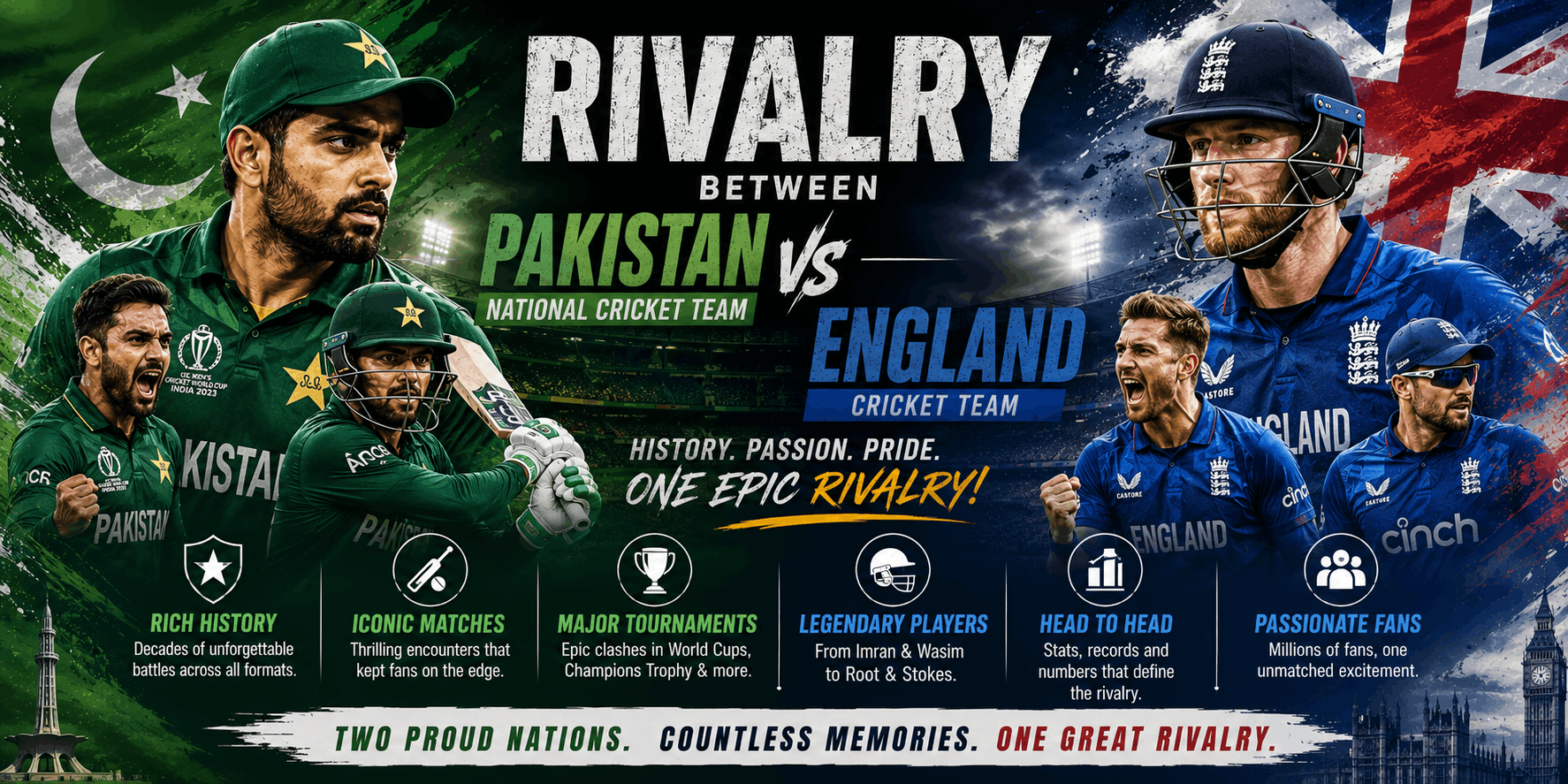
Few cricketing rivalries blend on-field drama with off-field controversy quite like the contest between the Pakistan national cricket team and the England cricket team. Since their first Test meeting at Lord’s in June 1954, these two nations have produced 72 years of cricket spanning Fazal Mahmood’s career-defining heroics, the unprecedented 2006 Oval forfeiture, Pakistan’s iconic 1992 World Cup triumph over their former colonial rulers, and the modern Bazball era’s high-scoring spectacles in Multan, Karachi, and Rawalpindi. Cricket fans across India, Pakistan, and the UAE — following on JioHotstar, Star Sports, and PTV Sports — have witnessed this rivalry evolve from a contest of post-colonial pride into one of the most statistically lopsided yet historically rich fixtures in international cricket. This comprehensive rivalry between the Pakistan national cricket team and the England cricket team timeline covers every significant era, format, iconic match, controversy, and player who has shaped this extraordinary cricketing relationship.
Rivalry Overview & Overall Head-to-Head Records
Cricket between Pakistan and England has always been one of the most respected and competitive rivalries in the sport. Since their first meeting in 1954, both teams have shared decades of thrilling encounters, unforgettable moments, and world-class performances. England’s technical precision and Pakistan’s natural flair have made every series between them worth watching.
As of October 2024, Pakistan have faced ten teams in Test cricket, with their most frequent opponent being England, playing 92 matches against them — confirming this as Pakistan’s single most contested Test rivalry in their entire cricketing history. England has been stronger in limited-overs matches, but Pakistan has recently improved in Tests, especially after winning their home Test series in 2024.
The rivalry’s defining characteristic is its statistical imbalance in white-ball cricket contrasted against genuine Test match competitiveness. With a 57-32 win-loss record, England’s superior batting depth and modern ODI strategies often outclass Pakistan. In T20Is, England has been dominant with 20 wins out of 31 matches. Yet despite this white-ball gap, the rivalry has produced some of cricket’s most historically significant moments — Pakistan’s 1992 World Cup final triumph over England, their stunning Champions Trophy 2017 semifinal demolition, and Test matches in both directions that rank among the finest contests either nation has played in any era.
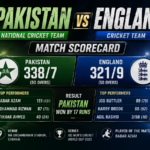
Read More: Pakistan National Cricket Team vs England Cricket Team Match Scorecard
Era 1 — Foundation Years (1954–1961): Fazal Mahmood’s Statement
June 10, 1954 — Lord’s: The First Meeting
1st Test at Lord’s, Jun 10-15, 1954, Match drawn, (Pak 87 and 121/3; Eng 117/9d). Pakistan’s first Test against England — just two years after gaining Test status — produced a cautious draw that reflected a touring side still finding its feet at the highest level of international cricket. The match’s significance lay not in the scoreline but in the symbolism: a newly independent nation’s cricket team facing their former colonial administrators at cricket’s most storied venue.
August 1954 — The Oval: Fazal Mahmood’s Historic 12-Wicket Match
Pakistan’s historic Test win at The Oval marked their arrival on the global stage. Fazal Mahmood’s 12-wicket haul stunned England and handed Pakistan their first-ever Test victory. This iconic match cemented Pakistan’s reputation as a competitive cricketing nation. Fazal’s swing bowling in English conditions remains one of the finest performances in Test history.
4th Test at The Oval – Aug 12-17, 1954, Pakistan won by 24 runs (Pak 133 and 164; Eng 130 and 143). Fazal Mahmood’s mastery of seam and swing on a damp Oval surface — exploiting English conditions with greater skill than England’s own bowlers managed against Pakistan’s batting — produced a result that announced Pakistan as a genuinely competitive Test nation just two years into their Test status. The low-scoring nature of the match, with all four innings totals under 165, reflected bowler-dominant conditions that Fazal exploited more completely than any England bowler across the match.
1961–1962 — Early Competitiveness Across Conditions
1st Test at Lahore – Oct 21-26, 1961, England won by 5 wickets (Pak 387/9d and 200; Eng 380 and 209/5). The early 1960s tours — played across both English and Pakistani conditions — established the rivalry’s competitive baseline. Pakistan’s batting depth, with Hanif Mohammad’s extraordinary patience anchoring their top order, gave them genuine competitiveness against England’s professional county-strengthened bowling attacks, even as victories remained relatively rare.
Era 2 — Building Competitiveness (1962–1986): Imran Khan’s Influence
The Imran Khan Transformation
Through the 1970s and into the 1980s, Imran Khan’s emergence as both an all-rounder of genuine world-class quality and an increasingly tactically sophisticated captain transformed Pakistan’s competitiveness against England. His pace bowling — combining genuine speed with late swing that troubled England’s top order consistently — gave Pakistan their first sustained period of bowling parity with England’s own attacks.
1st Test at Lord’s, London, Jul 14-17, Pakistan won by 75 runs (Pak 339 & 215; Eng 272 & 207). Pakistan’s victories at Lord’s during this period — cricket’s most symbolically important venue, the home of the sport’s governing traditions — carried additional psychological weight for a nation whose cricket identity had been shaped in direct response to English colonial influence.
1987 — Pakistan’s First Series Win in England
Pakistan’s 1987 tour of England produced their first Test series victory on English soil — a result built on Imran Khan’s captaincy, the emerging pace partnership of Wasim Akram and Waqar Younis in their formative years, and the batting class of Javed Miandad. This victory, arriving 33 years after their first Test meeting, confirmed Pakistan’s complete maturation as a Test cricket nation capable of defeating England in English conditions specifically — historically the most difficult achievement for subcontinental touring teams.
Era 3 — The 1992 World Cup Final: Pakistan’s Greatest Triumph
March 25, 1992 — Melbourne Cricket Ground: Cricket’s Most Symbolically Charged Final
Pakistan’s greatest ODI moment came at the Melbourne Cricket Ground, where they defeated England to lift their maiden World Cup trophy. Imran Khan’s leadership and a game-changing spell by Wasim Akram turned the match in Pakistan’s favor. This match is often seen as a turning point in Pakistan cricket, inspiring future generations and establishing the nation as a major force in the game.
Result: Pakistan won by 22 runs. Imran Khan’s “cornered tigers” — a team that had stumbled through the group stage before finding extraordinary form at the tournament’s most critical moments — defeated England in the final to claim Pakistan’s first and, to date, only Cricket World Cup title. Wasim Akram’s spell in the England run chase, featuring two deliveries of such extraordinary swing that they dismissed Allan Lamb and Chris Lewis in successive balls through reverse-swinging yorkers that no batsman in the world could have countered, provided the decisive passage of play.
The World Cup final’s broader significance extended deep into Pakistan’s national consciousness — a victory achieved by a team Imran Khan had assembled and inspired through sheer force of personality during a tournament where Pakistan had appeared eliminated before a providential rain-affected point against England in the group stage kept their campaign alive. The final against England specifically — their former colonial administrators, the nation whose cricket structures had originally shaped Pakistan’s own — gave the triumph a layer of symbolic resonance that Pakistan’s subsequent ICC tournament victories have never quite replicated.
Read More: 1992 Cricket World Cup — Complete Tournament History, Final & Pakistan’s Triumph
Era 4 — Reverse Swing Wars & Growing Tension (1992–2005)
Wasim and Waqar’s Reverse Swing Mastery
Through the 1990s, Pakistan’s pace bowling — led by Wasim Akram and Waqar Younis, whose mastery of reverse swing represented a genuine tactical innovation that other nations took years to fully understand and counter — made them consistently difficult opponents for England across both Test and ODI cricket. England’s batsmen, lacking domestic exposure to reverse swing bowling of comparable quality, frequently found Pakistan’s death-overs and second-innings bowling close to unplayable.
This period also saw the beginning of persistent controversy around ball-tampering allegations directed at Pakistan’s bowlers — accusations that English media and cricket establishment figures raised repeatedly as Wasim and Waqar’s reverse swing achieved results that traditional cricket wisdom suggested should not be possible through legal means alone. Pakistan had first been accused of ball-tampering — by England, as it happened — in 1992, a time when the secrets of reverse swing were not widely understood and were hotly debated. The issue dragged on for years in ICC committee rooms.
2000 — England’s Pakistan Tour Returns After a Gap
England’s tour of Pakistan in 2000 — their first full series in the country for several years — produced competitive Test cricket built around Pakistan’s continued spin and reverse-swing bowling strength against an England side gradually rebuilding under new leadership structures following a difficult decade of relative underachievement.
Era 5 — The Oval Forfeiture: Cricket’s Most Controversial Test (2006)
August 20, 2006 — The Oval, London: Cricket History’s Most Extraordinary Day
The fourth and final Test of England’s 2006 home series against Pakistan produced the single most controversial day’s play in the entire history of Test cricket — a match that ended not through normal cricketing means but through forfeiture, the only such conclusion in over 1,000 Test matches played to that point.
On 20 August 2006, during the fourth day of the fourth Test between England and Pakistan at The Oval, umpires Darrell Hair and Billy Doctrove ruled that the Pakistani team had been involved in ball tampering. They awarded five penalty runs to England and offered them a replacement ball. The Pakistani players refused to take the field after the tea interval in protest at the decision. The umpires left the field, directed the Pakistani players to resume play and returned once more 15 minutes later. After waiting two more minutes the umpires removed the bails and declared England winners by forfeiture. This was the first such end to a Test match in more than 1,000 Test matches.
The dismissal of Cook for 83 off the bowling of Umar Gul, with a delivery of reverse swing, resulted in umpires Darrell Hair and Billy Doctrove calling a halt to play so a set of used balls could be brought out to the middle: Hair and Doctrove ruled that the ball had been tampered with, and awarded 5 penalty runs to England. The accusation — directed at a Pakistan side that had bowled England out for 173 in the first innings before posting 504 themselves, a position of genuine dominance in the match — was perceived within Pakistan’s camp as both factually incorrect and a profound insult to the team’s collective and individual integrity.
Pakistan returned to the field after Inzamam-ul-Haq talked to PCB and ECB officials. Hair, however, said that if Pakistan took the field, he wouldn’t. The diplomatic chaos that followed — Pakistan’s cricket board, England’s cricket board, and the ICC all attempting to navigate a situation without precedent — produced years of subsequent legal and political wrangling over the match’s official result.
In 2008, the ICC changed the result to a draw, following political lobbying by the Pakistan board. But that reversed decision was disputed by the MCC, on the grounds that not to uphold the Laws set a “very dangerous” precedent, and the following year the ICC returned the result to an England victory.
The International Cricket Council (ICC), England and Wales Cricket Board (ECB) and Pakistan Cricket Board (PCB) later affirmed that the decision to award the match to England was in accordance with the laws of cricket. The ICC match referee Ranjan Madugalle later acquitted Pakistan captain Inzamam-ul-Haq of a ball-tampering charge, but banned him for four one day internationals for bringing the game into disrepute.
“I forgive Hair and will not take any action against him since we have been cleared of the more serious charge of ball-tampering — we should bury the matter,” Inzamam said. The Oval forfeiture remains, to this day, the most extraordinary single day’s play between these two nations and a permanent reference point whenever questions of umpiring authority, national pride, and the laws of cricket intersect in subsequent controversies across the sport.
Era 6 — UAE Exile & Pakistan’s Home Dominance (2010–2015)
The 2009 Lahore Attack & Pakistan’s Forced Relocation
Following the terrorist attack on the Sri Lankan cricket team’s bus in Lahore in March 2009, Pakistan lost their ability to host international cricket on home soil — a circumstance that fundamentally reshaped the Pakistan vs England rivalry for the following 16 years. Pakistan’s “home” matches against England, and against every other touring nation, were relocated to the United Arab Emirates — primarily Dubai, Abu Dhabi, and Sharjah — for matches played on used, slow, and increasingly spin-friendly surfaces that suited Pakistan’s bowling strengths considerably more than England’s traditional batting approach.
2010 — England’s Decisive Home Series Win Amid Spot-Fixing Scandal
1st Test at Trent Bridge, Nottingham, Jul 29-Aug 01, 2010, England won by 354-runs (Eng 354 and 262/9d; Pak 182 and 80) 2nd Test at Edgbaston, Birmingham, Aug 06-09, 2010, England won by 8-wickets 3rd Test at Kennington Oval, London, Aug 18-21, 2010, Pakistan won by 4-wickets 4th Test at Lord’s, London, Aug 26-29, 2010, England won by an innings and 225 runs. Result England 3, Pakistan 1.
The 2010 series carried the additional shadow of the spot-fixing scandal that emerged during the Lord’s Test — allegations against Mohammad Asif, Mohammad Amir, and captain Salman Butt for deliberately bowling no-balls at predetermined moments in exchange for payments from bookmakers. After Amir, Asif and Butt were dismissed, Pakistan made Misbah ul Haq the new captain of Pakistan. The scandal, breaking during an active series against England specifically, added another layer of controversy to a rivalry that already carried significant historical baggage from the 2006 Oval incident.
2012 — Pakistan’s UAE Fortress Demolishes England
1st Test at Dubai International Cricket Stadium, Jan 17-19, 2012, Pakistan won by 10 wickets (Eng 192 and 160; Pak 338 and 15/0) 2nd Test at Sheikh Zayed Stadium, Abu Dhabi, Jan 25-28, 2012, Pakistan won by 72 runs 3rd Test at Dubai International Cricket Stadium, Feb 03-06, 2012, Pakistan won by 71 runs. Result Pakistan 3.
Pakistan’s whitewash of England in their adopted UAE home conditions — built principally around Saeed Ajmal’s mystery spin and the doosra variation that England’s batsmen consistently struggled to read — produced one of the most one-sided Test series results in the rivalry’s modern history. The UAE conditions — slow, low, and offering significant turn for spinners by the third day — became Pakistan’s most reliable competitive advantage against England throughout this exile period, with their spin attack exploiting surfaces that English domestic cricket provided little preparation for.
2015 — UAE Series Continues, Misbah’s Captaincy
England’s subsequent tours to face Pakistan in the UAE continued to test their batsmen’s technique against spin in unfamiliar conditions, with Misbah-ul-Haq’s captaincy era providing Pakistan with tactical consistency and a settled squad combination that maximised their home-conditions advantage even while playing thousands of miles from Pakistan itself.
Read More: Pakistan Cricket’s UAE Exile Era — Complete History & Key Results 2009-2019
Era 7 — The 2017 Champions Trophy Final & Babar’s Emergence (2016–2022)
June 2017 — Cardiff: Hasan Ali’s Semifinal Demolition
In the 2017 ICC Champions Trophy, Pakistan’s bowling dismantled England in the semi-final, propelling them to ultimate glory. Pakistan’s crushing win over England in Cardiff during the 2017 ICC Champions Trophy is a modern classic. Hasan Ali’s brilliant spell decimated England’s batting lineup, while Pakistan’s batsmen chased the target with ease.
Pakistan’s semifinal victory over England — coming against an England side that had entered the tournament as overwhelming favourites in home conditions — became the platform for their subsequent Champions Trophy final triumph over India. Hasan Ali’s swing and seam bowling, combined with disciplined fielding and Pakistan’s improved batting depth under Sarfaraz Ahmed’s captaincy, produced one of the great underdog performances in ICC tournament knockout history.
2018–2020 — The Babar Azam Era Begins
Babar Azam’s emergence as Pakistan’s premier batsman through this period transformed their batting consistency against England across all formats. A standout moment was Pakistan’s victory in Nottingham in 2020, where Babar Azam and Mohammad Hafeez’s masterclass helped chase down a massive target. Babar’s technical correctness combined with controlled aggression — an approach that drew favourable comparisons to the great batsmen of previous eras — gave Pakistan a batting cornerstone capable of anchoring run chases against England’s varied bowling attacks across both home and away conditions.
Babar Azam is the leading run-scorer when it comes to T20Is between Pakistan and England. The right-handed batter has a brilliant record against England, as he has amassed 660 runs in 17 innings at an average of 47.14 and a strike rate of 141.02.
2021 — Whitewash & Decline
Pakistan’s failure against England were quite evident in the recently concluded three-match ODI series. The visitors faced a major hammering after being whitewashed 3-0 by a second-string England side. It was a moment of absolute shame for the Babar Azam-led side which drew criticism from all corners for their below-par performance against the hosts. This period of struggle against even England’s second-string squads exposed Pakistan’s continued vulnerability in white-ball cricket against England’s deep batting resources, a structural problem that persisted despite Babar’s individual batting excellence.
Era 8 — Bazball Returns to Pakistan (2022–2026)
December 2022 — Rawalpindi: Bazball’s Spectacular Pakistan Debut
England’s first full Test tour of Pakistan in 17 years — under Brendon McCullum and Ben Stokes’s revolutionary “Bazball” approach to Test cricket — produced an extraordinary series that redefined how visiting teams could approach Pakistan’s traditionally bowler-friendly, slow conditions.
England’s last trip to Pakistan in December 2022 was an extraordinary triumph, set in motion by their pedal-to-the-metal batting in the series opener in Rawalpindi, but epitomised by Ben Stokes’ magnificent captaincy throughout: from his perfectly weighted declaration to force victory on that dead deck, to his innovative slip-free field placings to prise out 20 wickets in similarly inhospitable conditions in Multan, and all the way through to his fearless faith in the rookie Rehan Ahmed, whose five wickets on debut in Karachi put a romantic seal on the campaign.
England’s 3-0 series sweep — achieved through unprecedented batting aggression that scored at run rates Test cricket had rarely witnessed against Pakistan’s spin-heavy attacks on traditionally slow surfaces — confirmed Bazball’s effectiveness even in conditions specifically designed to neutralise aggressive batting approaches.
October 2024 — Multan: The 823/7 Record & Pakistan’s Spin Counter-Attack
The highest innings total scored against Pakistan is by England when they scored 823/7d in the first Test of the England tour of Pakistan in 2024 at Multan. This extraordinary total — England’s batting depth fully exploiting a flat Multan surface with Bazball’s characteristic positive intent — represented the highest score England had ever posted against Pakistan and one of the highest totals scored against any opponent in the sport’s history.
Shan Masood’s captaincy faced significant pressure following this defeat, but Pakistan responded with a remarkable turnaround in the subsequent Tests of the series, deploying spin-friendly surfaces specifically engineered to counter England’s aggressive batting approach. Pakistan’s tactical response — preparing increasingly turning surfaces for the second and third Tests of the series — successfully neutralised England’s Bazball aggression and confirmed that Pakistan’s home conditions, when prepared specifically for the purpose, remained their most effective counter to England’s modern batting revolution. Pakistan has recently improved in Tests, especially after winning their home Test series in 2024.
February 2026 — T20 World Cup Super Eights: Brook’s Century Ends Pakistan’s Campaign
The most recent chapter of this rivalry — England’s two-wicket victory over Pakistan in the T20 World Cup 2026 Super Eights at Pallekele, powered by Harry Brook’s maiden T20I century of 100 off 51 balls — confirmed England’s continued dominance in white-ball ICC tournament cricket against Pakistan even as the Test rivalry has grown increasingly balanced through Pakistan’s improved home conditions strategy.
Read More: Pakistan vs England Match Scorecard — T20 World Cup 2026 Super Eights Full Analysis
Iconic Match Scorecards
Match 1 — 1992 World Cup Final (March 25, 1992, Melbourne Cricket Ground)
| Match Information | Details |
|---|---|
| Match | 1992 Cricket World Cup Final |
| Venue | Melbourne Cricket Ground, Australia |
| Result | Pakistan won by 22 runs |
| Key Performance | Wasim Akram’s match-defining spell |
Result: Pakistan won by 22 runs — Imran Khan’s leadership and a game-changing spell by Wasim Akram turned the match in Pakistan’s favor.
Match 2 — The Oval Forfeiture (August 17–21, 2006, London)
| Match Information | Details |
|---|---|
| Match | 4th Test, Pakistan tour of England 2006 |
| Venue | The Oval, London |
| Date | August 17–21, 2006 |
| Result | England awarded the match by forfeiture |
| Final Series Score | England 3-0 Pakistan |
Pakistan refused to come out after the tea interval, leading to the umpires awarding the match to England 20 minutes later. Despite Pakistan later being willing to play, the umpires insisted the result must stand. This remains the only Test match in cricket history decided by forfeiture rather than normal play.
Match 3 — 2017 Champions Trophy Semifinal (June 14, 2017, Cardiff)
| Match Information | Details |
|---|---|
| Match | ICC Champions Trophy 2017, Semifinal |
| Venue | Sophia Gardens, Cardiff |
| Result | Pakistan won comfortably |
| Player of the Match | Hasan Ali |
Hasan Ali’s brilliant spell decimated England’s batting lineup, while Pakistan’s batsmen chased the target with ease, sending Pakistan into the final against India, which they won to claim the Champions Trophy title.
Match 4 — England’s 823/7 at Multan (October 2024)
| Match Information | Details |
|---|---|
| Match | 1st Test, England tour of Pakistan 2024-25 |
| Venue | Multan Cricket Stadium |
| Date | October 2024 |
| England 1st Innings | 823/7 declared — highest ever total against Pakistan |
The highest innings total scored against Pakistan is by England when they scored 823/7d in the first Test of the England tour of Pakistan in 2024 at Multan.
Match 5 — Pakistan vs England, T20 World Cup 2026 Super Eights (February 24, 2026, Pallekele)
| Match Information | Details |
|---|---|
| Match | T20 World Cup 2026, Super Eights |
| Venue | Pallekele International Cricket Stadium, Sri Lanka |
| Result | England won by 2 wickets |
| Player of the Match | Harry Brook (100 off 51 balls) |
England 166 for 8 (Brook 100, Afridi 4-30) beat Pakistan 164 for 9 (Farhan 63, Dawson 3-24) by two wickets.
Head-to-Head Records — All Formats
| Format | Matches Played | England Won | Pakistan Won | Drawn/NR/Tied |
|---|---|---|---|---|
| Tests | 92 | ~32 | ~24 | ~36 draws |
| ODIs | 92 | 57 | 32 | 3 NR |
| T20Is | 31 | 20+ | 8-11 | 1 Super Over |
| Overall | 215+ | ~110 | ~65 | — |
England and Pakistan have faced each other in 92 matches in ODI. Out of these 92 games, England have won 57 whereas Pakistan have come out victorious on 32 occasions. 3 matches ended without a result.
Out of the 18 T20Is, England have come up trumps in 11 matches while Pakistan have won five matches. More recent data shows the gap widening further: The teams have played 24 T20Is against each other with the Pakistan cricket team winning just 8 and England winning 15, one out of which was won after a Super Over.
Top Run-Scorers Across All Formats
| Player | Team | Format | Notable Achievement |
|---|---|---|---|
| Babar Azam | Pakistan | T20I | 660 runs in 17 innings at average 47.14 — leading T20I run-scorer vs England |
| Javed Miandad | Pakistan | Tests/ODIs | Sustained excellence across two decades |
| Alastair Cook | England | Tests | Multiple centuries including 83 in the 2006 Oval Test |
| Joe Root | England | Tests | Consistent across multiple Pakistan tours |
| Mohammad Yousuf | Pakistan | Tests | Double-century in 2006 series |
| Inzamam-ul-Haq | Pakistan | Tests/ODIs | Captain through multiple eras vs England |
| Harry Brook | England | T20I | 100* in 2026 T20 World Cup Super Eights |
Top Wicket-Takers Across All Formats
| Player | Team | Format | Notable Achievement |
|---|---|---|---|
| Fazal Mahmood | Pakistan | Tests | 12-wicket match haul at The Oval, 1954 |
| Wasim Akram | Pakistan | All | World Cup Final-winning spell, 1992 |
| Waqar Younis | Pakistan | All | Reverse swing mastery across 1990s |
| James Anderson | England | Tests | Sustained excellence across multiple Pakistan tours |
| Saeed Ajmal | Pakistan | Tests | Whitewash architect, UAE 2012 series |
| Hasan Ali | Pakistan | ODI | Champions Trophy 2017 semifinal demolition |
| Shaheen Shah Afridi | Pakistan | All | 4/30 in 2026 T20 World Cup |
Venue-Wise Records
| Venue | Format | Pakistan Record | England Record |
|---|---|---|---|
| The Oval, London | Tests | 1954 win; 2006 forfeiture loss | Mixed |
| Lord’s, London | Tests | Multiple historic wins | England home stronghold |
| Multan Cricket Stadium | Tests | Spin-friendly home advantage | 823/7 in 2024 (record) |
| Rawalpindi | Tests | Traditionally flat | England Bazball dominance 2022 |
| Dubai/Abu Dhabi (UAE exile era) | Tests | Pakistan whitewash 2012 | England struggled vs spin |
| Multiple England venues | ODI/T20I | England favoured | England’s strongest format advantage |
Turning Points That Redefined the Rivalry
1954 — Fazal Mahmood’s Oval 12-Wicket Match: Pakistan’s historic Test win at The Oval marked their arrival on the global stage, establishing competitive parity just two years into Pakistan’s Test status.
1992 World Cup Final: Pakistan’s 22-run victory over England remains the single most significant result in this rivalry’s entire history — the moment Pakistan defeated their former colonial administrators on the world’s biggest stage to claim their only World Cup title.
2006 The Oval Forfeiture: The unprecedented ball-tampering controversy and subsequent forfeiture fundamentally altered the diplomatic dynamic between the two cricket boards for years and remains cricket’s most extraordinary single-match controversy.
2009 Lahore Attack & UAE Exile: Pakistan’s forced relocation from home soil fundamentally reshaped the rivalry’s tactical dynamic for 16 years, with UAE’s slow, spin-friendly surfaces becoming Pakistan’s primary competitive advantage against England.
2017 Champions Trophy Semifinal: Hasan Ali’s brilliant spell decimated England’s batting lineup, launching Pakistan’s run to their Champions Trophy title and confirming their continued capacity for ICC tournament upsets against England.
2022–2024 — Bazball’s Pakistan Tours: England’s revolutionary aggressive batting approach, first deployed successfully in 2022 and then countered tactically by Pakistan’s spin-friendly pitch preparation in 2024, represents the rivalry’s most significant tactical evolution of the modern era.
Star Players Who Defined Each Era
Fazal Mahmood (Pakistan, 1952–1962): The architect of Pakistan’s earliest competitiveness against England, his 12-wicket Oval performance in 1954 remains a defining moment in Pakistan cricket history.
Imran Khan (Pakistan, 1971–1992): Pakistan’s greatest captain and all-rounder, his leadership delivered the 1992 World Cup triumph over England and established Pakistan’s competitive Test cricket identity across two decades.
Wasim Akram & Waqar Younis (Pakistan, 1985–2003): The reverse-swing pioneers whose mastery troubled England’s batsmen consistently across the 1990s, fundamentally changing fast bowling tactics throughout world cricket.
Inzamam-ul-Haq (Pakistan, 1991–2007): Pakistan’s captain through the 2006 Oval controversy, his statesmanlike response to the forfeiture crisis — “I forgive Hair and will not take any action against him” — reflected leadership under unprecedented pressure.
Babar Azam (Pakistan, 2015–present): The leading run-scorer in T20Is between Pakistan and England with 660 runs in 17 innings, his technical excellence has been Pakistan’s most consistent batting weapon against England across the modern era.
Ben Stokes (England, 2017–present): His captaincy transformed England’s approach to playing in Pakistan, delivering the historic 2022 series whitewash through Bazball’s aggressive philosophy.
Harry Brook (England, 2022–present): His maiden T20I century against Pakistan in the 2026 T20 World Cup Super Eights confirmed his emergence as England’s defining modern batting talent against this opponent specifically.
Read More: Ben Stokes — Bazball Captaincy, Career Stats & Test Records
Match Summary & Conclusion
The rivalry between the Pakistan national cricket team and the England cricket team is one of international cricket’s most historically complex relationships — a contest shaped as much by political and diplomatic episodes as by the cricket itself. England’s technical precision and Pakistan’s natural flair have made every series between them worth watching. From Fazal Mahmood’s foundational Oval triumph to Imran Khan’s World Cup glory, from the unprecedented 2006 forfeiture to Pakistan’s UAE exile resilience, from Hasan Ali’s Champions Trophy heroics to the modern Bazball spectacles in Multan and Rawalpindi, this rivalry has consistently produced moments that transcend conventional cricket analysis.
England’s statistical dominance in white-ball cricket — a 57-32 win-loss record in ODIs and a similarly comprehensive T20I lead — contrasts with a Test rivalry that remains genuinely competitive, particularly as Pakistan’s 2024 home series response demonstrated their continued ability to neutralise England’s most aggressive modern tactics through intelligent home-conditions preparation. As both nations continue developing their next generations of talent — England’s Bazball revolution evolving under Brook’s captaincy, Pakistan rebuilding their bowling and batting depth around Babar Azam’s continued excellence — the rivalry between the Pakistan national cricket team and the England cricket team enters its eighth decade with every indication that its capacity for drama, controversy, and genuine cricketing excellence remains entirely undiminished.
Frequently Asked Questions
What is the head-to-head record between Pakistan and England in Test cricket?
Pakistan have played 92 Test matches against England — their most frequent Test opponent of any nation. England holds a lead in total wins, though Pakistan has shown significant improvement in recent years, particularly with their 2024 home series response to England’s Bazball approach.
What was the result of the 1992 Cricket World Cup Final between Pakistan and England?
Pakistan defeated England by 22 runs at the Melbourne Cricket Ground to win their maiden and only World Cup title. Imran Khan’s leadership and Wasim Akram’s match-defining bowling spell turned the match in Pakistan’s favour.
What happened in the 2006 Oval Test between Pakistan and England?
On August 20, 2006, umpires Darrell Hair and Billy Doctrove ruled that Pakistan had tampered with the ball during the fourth Test at The Oval. Pakistan refused to take the field after tea in protest, leading the umpires to remove the bails and award the match to England by forfeiture — the first such conclusion to a Test match in over 1,000 Tests.
Who has the best individual record for Pakistan against England?
Babar Azam is the leading run-scorer in T20Is between Pakistan and England, with 660 runs in 17 innings at an average of 47.14 and a strike rate of 141.02. In Test cricket, Fazal Mahmood’s 12-wicket haul at The Oval in 1954 remains one of the finest individual bowling performances by any Pakistan player against England.
What is England’s highest Test total against Pakistan?
The highest innings total scored against Pakistan is by England, who scored 823/7 declared in the first Test of their 2024 tour of Pakistan at Multan — the highest total England have ever posted against Pakistan.
Who won the 2017 ICC Champions Trophy semifinal between Pakistan and England?
Pakistan defeated England comprehensively in the Champions Trophy 2017 semifinal at Cardiff. Hasan Ali’s brilliant bowling spell decimated England’s batting lineup, sending Pakistan into the final, which they won against India to claim the title.
Where can fans in India, Pakistan and the UAE watch Pakistan vs England matches?
Pakistan vs England matches are broadcast on Star Sports and streamed on JioHotstar for Indian audiences. Pakistani viewers can watch on PTV Sports and A Sports. UAE-based fans can access coverage through CricLife Max and StarzPlay.